On this day in 1940, John T. S. Hunn and Miriam Minton were birding south of South Plainfield in Middlesex County. The original goal of their day was to find Upland Sandpipers, but Hunn heard a song he recognized from trips out west as belonging to a Western Meadowlark. Although Hunn returned to the location several times during May 1940, the bird was never refound.
It was a good thing that Hunn knew the Western Meadowlark's song, since Eastern and Western meadowlarks look very similar and the best method of distinguishing them is by song. There have been seven accepted records since, all from the spring to summer season. In contrast to many NJ rarities, all Western Meadowlarks so far have been away from the expected coastal rarity magnets such as Cape May or Sandy Hook.
Hunn, John T. S. 1941. Western Meadowlark in New Jersey. Auk 58:265. PDF here
Tuesday, April 28, 2009

Wednesday, April 22, 2009
Whip-poor-will
On this day in 1749, Pehr Kalm set down some notes about the Whip-poor-will. The impetus for his journal entry was the arrival of the species on this day of that year. Kalm's teacher, Carl Linne (Linnaeus) considered the Whip-poor-will a variety of the European Nightjar, but Kalm noted that the species' voice was different from the European bird. He compared it to the Common Cuckoo of Europe for its habit of remaining unseen by day but calling at night. He also wrote, "It commonly comes several times in a night, and settles close to the houses; I have seen it coming late in the evening, settling on the steps of the house in order to sing its song" (Kalm 1987). Kalm also relates the story of a Whip-poor-will that played dead when his servant attempted to shoot it.
The photo that illustrates this post shows what would have been a brand new house in 1749; the Whitall House in National Park, Gloucester County, which was built in 1748. A fine example of the brick houses of that era, its fame was sealed when it found itself a front-row spectator of the Battle of Red Bank in 1777.
Kalm, Peter. 1987. Peter Kalm's Travels in America. Dover, New York, NY.
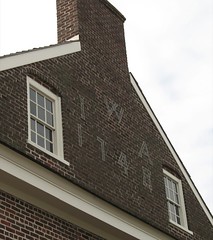
The photo that illustrates this post shows what would have been a brand new house in 1749; the Whitall House in National Park, Gloucester County, which was built in 1748. A fine example of the brick houses of that era, its fame was sealed when it found itself a front-row spectator of the Battle of Red Bank in 1777.
Kalm, Peter. 1987. Peter Kalm's Travels in America. Dover, New York, NY.
Monday, April 20, 2009
Mothy Monday 4: The Dark Side
There was a time when birders were seen as having no interest in other aspects of the natural world apart from birds. I'm sure there have always been well-rounded naturalists, and birders who were interested in learning about other types of fauna and flora, but the stereotype was something I became aware of as I "grew up" as a birder (and yes, was primarily interested in birds).
Time passed, though, and as it did, I got more interested in insects. Butterflies were the initial flirtation, then came dragonflies and damselflies. But moths were the group that really sucked me in.
Lo and behold, as I started looking for identification information on these insect groups, I came across names that I knew (even if I didn't know the people in question) as birders. But here they were, often putting up complicated and useful resources on the web, not for bird ID, but for bug ID. I think this is why one birder I know refers to birders getting interested in insects as "going over to the Dark Side."
Well, if I had any doubt that I had gone over to the Dark Side myself (honestly, I've suspected it for a while; if I'm digiscoping Elderberry Borers, that obviously means it's high time for an intervention)
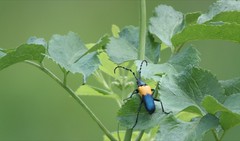
the moth that illustrates this post sounded the final death knell.
For sixteen years (ouch), a friend of mine and I have been doing something we call the March Ramble. We wander around Cape May County in late March and try to find as many species of waterfowl as possible (twenty is the goal). We also like to build a good day list of other birds. It's a very relaxed Big Day; some years (such as this one) the Ramble slides into early April. The day totals are usually around 70-80 species, and the cumulative total is over 100.
This year, when we arrived at Bunker Pond, we walked up onto the hawkwatch platform and set up the scopes to look out on the pond. As we did, I saw a tiny fluttery thing flush and fly off. I knew it had to be a moth. I watched its flight; luckily, it landed on another part of the platform.
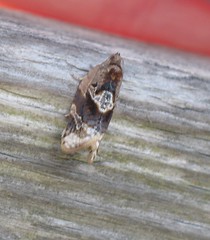
Then, with my scope ready to scan Bunker Pond for various species of waterfowl and other birds, I walked away from it and took this picture of a tiny but nicely-patterned moth that turned out to be a Red-banded Leafroller Moth (Argyrotaenia velutinana). I made sure I had a good photo of the moth (for ID purposes) before walking back to my scope and getting back to birding. Yes, I have truly gone over to the Dark Side.
Time passed, though, and as it did, I got more interested in insects. Butterflies were the initial flirtation, then came dragonflies and damselflies. But moths were the group that really sucked me in.
Lo and behold, as I started looking for identification information on these insect groups, I came across names that I knew (even if I didn't know the people in question) as birders. But here they were, often putting up complicated and useful resources on the web, not for bird ID, but for bug ID. I think this is why one birder I know refers to birders getting interested in insects as "going over to the Dark Side."
Well, if I had any doubt that I had gone over to the Dark Side myself (honestly, I've suspected it for a while; if I'm digiscoping Elderberry Borers, that obviously means it's high time for an intervention)
the moth that illustrates this post sounded the final death knell.
For sixteen years (ouch), a friend of mine and I have been doing something we call the March Ramble. We wander around Cape May County in late March and try to find as many species of waterfowl as possible (twenty is the goal). We also like to build a good day list of other birds. It's a very relaxed Big Day; some years (such as this one) the Ramble slides into early April. The day totals are usually around 70-80 species, and the cumulative total is over 100.
This year, when we arrived at Bunker Pond, we walked up onto the hawkwatch platform and set up the scopes to look out on the pond. As we did, I saw a tiny fluttery thing flush and fly off. I knew it had to be a moth. I watched its flight; luckily, it landed on another part of the platform.
Then, with my scope ready to scan Bunker Pond for various species of waterfowl and other birds, I walked away from it and took this picture of a tiny but nicely-patterned moth that turned out to be a Red-banded Leafroller Moth (Argyrotaenia velutinana). I made sure I had a good photo of the moth (for ID purposes) before walking back to my scope and getting back to birding. Yes, I have truly gone over to the Dark Side.
Friday, April 17, 2009
White-faced Ibis

On this day in 1977, J. Galli and J. Penkala found a White-faced Ibis at Brig (aka Forsythe NWR). The bird was refound on 21 April at Tuckerton. This record was so unprecedented that it merited an S.A. in the relevant issue of American Birds. From that issue: "This is a first regional record, and the fourth for the east" (Paxton et al. 1977).
Since then, White-faced Ibises have become almost routine in the state. World Series of Birding teams try to pin them down in the spring, and the typical intermittent reports of them at locations like Brig over the summer challenge birders while at the same time encouraging them to ignore the ibises as routine birds.
Paxton, Robert O., Paul A. Buckley, & David A. Cutler. 1977. The Spring Migration, Hudson-Delaware Region. American Birds 31:979-984.
Wednesday, April 15, 2009
The Moth and Me #2

I know it's not Monday, but the latest installment of a new blog carnival called The Moth and Me is now up. I had intended to submit something for it, but never got around to it because I was distracted by homework and such. No fear; Seabrooke Leckie at North American Moths Backyard Inventory (NAMBI) was kind enough to pick up a couple of my Mothy Monday posts. So, here's The Moth and Me #2.
Seabrooke is working on the range maps for a new Peterson guide to Northeastern moths (due 2012, so don't be camping out at your local bookstore just yet) and the blog is part of a drive to get more data for the maps. There's also a NAMBI Flickr pool. The blog features lots of attractive moth photos and tips on identification and mothing technique, so it's well worth reading.
Saturday, April 04, 2009
Tuckerton Bird Names
Continuing in a series of old bird names from various Jersey locations drawn from Gurdon Trumbull's Names and Portraits of Birds..., this list is of Tuckerton bird names. The decoy that illustrates this post probably would've been considered a brown-back.
Bay-coot - Surf Scoter
Big Yellow-legged Plover - Greater Yellowlegs
Black-breast - Dunlin
Black-breast Plover - Black-bellied Plover
Blaten Duck - Gadwall
Brant-snipe - Dunlin
Broad-bill - Greater Scaup
Brown-back - Short-billed Dowitcher
Bull-head - Black-bellied Plover
Cock-robin - Hooded Merganser
Cock-robin Duck - Hooded Merganser
Creek Broad-bill - Lesser Scaup
Crow-duck - American Coot
Cub-head - Common Goldeneye
Fat-bird - Pectoral Sandpiper
Field Plover - Upland Sandpiper
Fresh-water Sheldrake - Common Merganser
Gannet - Ruddy Turnstone
Long-billed Curlew - Long-billed Curlew
Marlin - Marbled Godwit
Mud-hen - Clapper Rail
Quill-tail Coot - Ruddy Duck
Robin-snipe - Red Knot
Salt-water Sheldrake - Red-breasted Merganser
Short-billed Curlew - Whimbrel
Shovel-bill - Northern Shoveller
Sleepy Broad-bill - Ruddy Duck
Small Yellow-legged Plover - Lesser Yellowlegs
Smees - Northern Pintail
Smethe - Northern Pintail
Sprig-tail - Northern Pintail
Telltale - Greater Yellowlegs, Lesser Yellowlegs
Winter Snipe - Dunlin
Friday, April 03, 2009
A Little Link Love
No, really, I'm still here. But I have to say that being a grad student while holding down a job and serving on a BRC can definitely have its time management challenges (not that you need to get out the violins or anything). However, I noticed a couple of interesting posts this week and suspect they might be of interest to anyone reading this blog (assuming anyone is patient or forgiving enough to still be out there!).
1. For anyone curious about the daring, high-stakes, glamorous life of a New Jersey Birds regional editor, wait no longer. Patrick Belardo has written a great exposé on The Hawk Owl's Nest. Since Patrick is now Region 2 Editor, he is the lucky soul who will be receiving my local sightings. I guess I'd better get to work on learning my way around the eBird interface...
2. Just recently there was a discussion on the BRC listserv regarding photographic documentation and how it is swamping other sorts of documentation. I'm working on a blog series on this topic, but in the meantime, a software package was announced earlier this week that should gladden the heart of the most Old School BRC member (unless that BRC member is so Old School as to still demand a specimen).
and, as a Rutgers grad student...
3. I've got to give a shout-out to David La Puma and the Scarlet Knight Herons, who are doing the World Series of Birding this year to benefit the Rutgers University Graduate Student Association. Of course they have a blog.
Saturday, March 21, 2009
New Jersey Birds Winter 2009
I've been remiss here in noting the appearance of the Winter 2009 issue of New Jersey Birds. This is the first online-only issue of the journal. In addition to the normal seasonal reports, it includes an article on NJ's first Long-billed Murrelet. You can find the PDF here.
The decision to make NJB an online journal was, to put it mildly, a controversial one. Personally, I prefer leafing through my stacks of back (print) issues (and do so on a regular basis, between random curiosity, researching a project, and looking up something for NJBRC business). As someone who has written for (and, more importantly, reported sightings to) the journal in the past, I can't help but wonder what the future holds for NJB. I do hope it continues, since it is an essential source of information on the state's birds.
The decision to make NJB an online journal was, to put it mildly, a controversial one. Personally, I prefer leafing through my stacks of back (print) issues (and do so on a regular basis, between random curiosity, researching a project, and looking up something for NJBRC business). As someone who has written for (and, more importantly, reported sightings to) the journal in the past, I can't help but wonder what the future holds for NJB. I do hope it continues, since it is an essential source of information on the state's birds.
Monday, March 09, 2009
Mothy Monday 3: Spring Cankerworm Moth
I'm kind of surprised that I haven't yet seen a Green Cloverworm Moth this year (they are fairly hardy). But now it's March and, right on schedule, a Spring Cankerworm Moth showed up a few days ago. I also found a Phigalia sp. (possibly The Half-wing, or possibly not) over the weekend; again, Phigalias (Phigaliae?) tend to show up early in the season.
Spring Cankerworm Moths are unassuming gray Geometers that hold their wings more like Noctuids (i.e., not spread like a pinned specimen as many Geometers do but folded over the moth's back).

Spring Cankerworm Moths are unassuming gray Geometers that hold their wings more like Noctuids (i.e., not spread like a pinned specimen as many Geometers do but folded over the moth's back).
George Wenzelburger
Yesterday, Bob Dodelson reported the passing of George Wenzelburger to the JerseyBirds listserv. George had been ill for some time, so this news was not exactly a surprise, but it was still very sad news.
I did not know George well or long. I never had the opportunity to go birding with him. I made his acquaintance when I became involved with the NJ Bird Records Committee. During George's last term on the committee, spring meetings were customarily held at his house in Freehold, where he and his wife were the best of hosts. I wish I could say something more profound, but that will probably come from those who knew him best. I can only say I deeply regret his passing and my thoughts are with his family and friends.
If you have a stack of old issues of (Records of) New Jersey Birds, you might pull out volume 29, number 4 (the winter 2003-2004 issue), and read George's writeup on NJ's first (and so far only) Masked Booby.
Rest in peace.
Monday, March 02, 2009
Mothy Monday 2: Unidentified Noctuid
On this snowy, blustery, not at all springy March day, it's probably appropriate to post the first moth of the season. It's a Noctuid, perhaps from the Eupsilia genus, but beyond that I dare not go. Moth identification makes Empidonax flycatchers look easy (because Emps sing and call, at least). The first moth of the season is still a sign of spring, though, just as much as the Red-winged Blackbirds setting up shop on the creek out back.

Saturday, February 28, 2009
Barnegat Bird Names
A trip out the jetty at Barnegat last weekend provides an excuse to list some historic game bird names from Barnegat gunners (via Trumbull's Names and Portraits of Birds...
Big Yellow-leg - Greater Yellowlegs
Black-breast Plover - Black-bellied Plover
Blaten Duck - Gadwall
Brant-snipe - Dunlin
Broad-bill - Greater Scaup
Brown-back - Short-billed Dowitcher
Checkered-snipe - Ruddy Turnstone
Cock-robin - Hooded Merganser
Cock-robin Duck - Hooded Merganser
Crow-duck - American Coot
Cub-head - Common Goldeneye
Dowitch - Short-billed Dowitcher
Field Plover - Upland Sandpiper
Fresh-water Broad-bill - Lesser Scaup
Fresh-water Sheldrake - Common Merganser
Gray Plover - Black-belled Plover
Krieker - Pectoral Sandpiper
Large Yellow-leg - Greater Yellowlegs
Little Yellow-leg - Lesser Yellowlegs
Marlin - Marbled Godwit
Mud-hen - Clapper Rail
Ring-tailed Marlin - Hudsonian Godwit
Robin-snipe - Red Knot
Salt-water Sheldrake - Red-breasted Merganser
Sleepy Broad-bill - Ruddy Duck
Small Curlew - Whimbrel
Small Yellow-leg - Lesser Yellowlegs
Spoon-bill - Northern Shoveller
Sprig-tail - Northern Pintail
Telltale - Greater Yellowlegs, Lesser Yellowlegs
The birds that illustrate this post, Harlequin Ducks, are generally expected by birders visiting Barnegat today, but according to Trumbull in the day, did not get much south of Salem, Massachusetts. In their accepted range, they were usually known as "lord and lady."
Tuesday, February 24, 2009
Bridled Tern
On this day in 1951, Evelyn and Quintin Kramer found a carcass of a long-dead Bridled Tern at Island Beach State Park in Ocean County. Subsequent records of the species have been associated with hurricanes and tropical storms, when it is almost expected (if not quite as common as Sooty Tern in these circumstances).
The obituary of Quintin Kramer that appeared in Cassinia contains the following: "During World War II, Quintin and Evelyn did most of their birding by public transportation and shank's mare. They walked the Jersey beaches for miles and found numerous dead birds, including an occasional rare species" (Peniston 1976). Presumably, this tern was carried north with a tropical storm during the summer of 1950. Unisys shows 13 storms for that season; the likeliest candidates to drop a tropical tern in NJ would seem to be Able and Dog (but I'm open to contrary opinions from those who have studied the intersection of hurricanes and birds in more detail than I have). In any case, the Kramers came along after the fact, and the specimen in question now resides at the Academy of Natural Sciences in Philadelphia.
Peniston, Howell. 1976. Quintin Kramer 1908-1975. Cassinia 56: 6. PDF here
Tuesday, February 03, 2009
Bohemian Waxwing
On this day in 1962, a Bohemian Waxwing was found in Princeton, Mercer County. The bird stayed until the 9th and was seen by many; NJ's second and third records followed quickly, with another bird at Riverton in Burlington County on 17 March, and one at Flemington Junction in Hunterdon County 10-22 April.
As one might surmise from this cluster of records, the winter of 1961-1962 was a good one for Bohemian Waxwings. Like many winter irruptive species, the best cue to look out for them in NJ is their presence in nearby states. They sometimes appear in small numbers along the coast in a flight year (Sandy Hook and Island Beach are good places to check), but they can turn up anywhere.
A somewhat amusing footnote to the first state record is that the sighting was written up in the New York Times by an unnamed author. This brief note is worth seeking out if you want a lay person's view of birding in the early 1960s. The waxwing is referred to as "jaunty and resplendent," and the roll call of other winter irruptives reported in that season included, "Red-breasted nuthatches, redpolls, browncapped (or arboreal) chickadees and pine grosbeaks" (Anon. 1962). Even making allowances for the arboreal chickadees, it sounds like the winter of 1961-1962 was not a bad time to be a birder.
Anonymous. 1962. Bohemian Waxwing Is Spotted in Jersey in Rare Appearance. New York Times February 27, 1962, p. 35.
Monday, February 02, 2009
Mothy Monday 1: Large Tolype
Go figure; I'm going to try to get myself back in the groove of posting to my birding blog by writing a moth post.
I first saw a Large Tolype at a rest stop not far from Sturbridge, Massachusetts. My cohorts and I were chasing (unsuccessfully) the Western Reef-Heron that was being reported from New Hampshire. I had just gotten my digital camera and had already had my interest piqued by moths, so I couldn't resist taking some photos of the moths on the side of a fast-food restaurant. It's a good thing that the manager (who came out to see what the heck we were up to) didn't call local law enforcement.
Then, a few days after I came home, I found a Tolype outside my door. That's the one you see here.
Tolypes are part of the Lasiocampidae, or Tent Caterpillar and Lappet Moths.
Thursday, October 30, 2008
Black-throated Sparrow
On this day in 1961, a Black-throated Sparrow showed up at a feeder maintained by Mrs. H. MacKenzie near New Brunswick in Middlesex County. According to John Bull, who did the writeup in the Auk, "She reported that it fed on marigold seeds as well as a mixture of 'wild bird' feed," (in case you have any ideas about getting Black-throated Sparrows at your feeder this winter). The bird stayed until 23 April of the following year and was seen by "hundreds" (Bull, again) of birders. There have been two more accepted records of Black-throated Sparrows in the state since then, both starting in mid-December: one in 1974-1975 and another in 1992-1993.
The bottom line is that most birds that visit feeders are the expected ones, but way-out-of-range birds are in no position to shun feeders and a fair number of rarities over the years have turned up in this situation.
Bull, John L. 1963. Black-throated Sparrows in the eastern United States. Auk 80:379-380. PDF here
"We take you now to Grovers Mill, New Jersey"
On this day in 1938, a Martian saucer landed in the bucolic setting of Grover's Mill, a mere stone's throw from where I currently reside. I have to say, given the remaining traces on the landscape, it's as if it never happened; all that's left is this monument and, of course, the typical local pride that comes along with something so momentous having happened in the immediate neighborhood. Why, even the old mill that gave Grover's Mill its name survives. The Yoyodyne Systems campus is difficult to locate, but that comes as no surprise given its checkered history, as well as the plentitude of corporate campuses (campii?) along this part of the Rt. 1 corridor.
What many people don't realize is that another Martian craft landed in the Great Swamp, an NWR that seems ignorant of its connection to this event. According to a news bulletin of the time from Basking Ridge, it was discovered by hunters, although the pinpointing of its location as "twenty miles south of Morristown" is wildly inaccurate. I guess that if the newscasters of the day had had access to modern-day bird-finding guides, they might have done a bit better. Or perhaps they were somewhat over-excited by the unprecedented events they were called upon to report.
As usual, seeking a birdy connection to this non-birding event, I came up short. The best I could do was the report of "black birds" that feasted upon the unlucky Martians' remains in Central Park; perhaps NJ corvids from the Newark and Secaucus marshes joined the mayhem, but that would require further digging into historical crow roost reports, some of which were notably vague due to concern over persecution.
War of the Worlds script
War of the Worlds website
Wired post on War of the Worlds
Monday, October 27, 2008
The Perfect Birding Librarian Storm
As a birding LIS student, I just couldn't resist blogging this.

When my mom asked about Bar-tailed Godwits the other night on the phone, I knew a bird celebrity had been born. Sure enough, today the Dewey Blog had an entry entitled "Migration of Bar-Tailed Godwits". If you had any reason to wonder what Dewey Decimal Number such a migration would get, wonder no longer.
All four species of godwits have been recorded in NJ. The first Bar-tail showed up at Absecon in 1937, and one bird visited Longport from 1972 to 1982. The last NJ record was from Nummy's Island in September 1985.
Thursday, October 02, 2008
Ruff
On this day in 1932, Charles Urner found two Ruffs near Tuckerton, Ocean County. In that day, on the cusp between specimen and sight identification, Urner took no specimens but notes, then repaired to specimens to double-check his conclusions. This was not the first record of Ruff for NJ, since there was at least one previous specimen record cited in Chapman (1906).
In subsequent years, Ruffs became synonymous with Pedricktown in springtime, but that is not so much the case now. They seem to be easier to find in Delaware than Jersey these days, at least in spring.
Urner, Charles A. 1933. The Ruff in New Jersey. Auk 50:101. PDF here
In subsequent years, Ruffs became synonymous with Pedricktown in springtime, but that is not so much the case now. They seem to be easier to find in Delaware than Jersey these days, at least in spring.
Urner, Charles A. 1933. The Ruff in New Jersey. Auk 50:101. PDF here
Monday, September 29, 2008
Western Kingbird
On this day in 1894, A. H. Phillips found a Western Kingbird (in that day, an Arkansas Kingbird) in Princeton, Mercer County, and took it as a specimen. This was just the first recorded instance of what has become an expected fall vagrant in NJ: so expected, in fact, that it has never been a Review List species.
Subscribe to:
Posts (Atom)