On this day in 1962, a Bohemian Waxwing was found in Princeton, Mercer County. The bird stayed until the 9th and was seen by many; NJ's second and third records followed quickly, with another bird at Riverton in Burlington County on 17 March, and one at Flemington Junction in Hunterdon County 10-22 April.
As one might surmise from this cluster of records, the winter of 1961-1962 was a good one for Bohemian Waxwings. Like many winter irruptive species, the best cue to look out for them in NJ is their presence in nearby states. They sometimes appear in small numbers along the coast in a flight year (Sandy Hook and Island Beach are good places to check), but they can turn up anywhere.
A somewhat amusing footnote to the first state record is that the sighting was written up in the New York Times by an unnamed author. This brief note is worth seeking out if you want a lay person's view of birding in the early 1960s. The waxwing is referred to as "jaunty and resplendent," and the roll call of other winter irruptives reported in that season included, "Red-breasted nuthatches, redpolls, browncapped (or arboreal) chickadees and pine grosbeaks" (Anon. 1962). Even making allowances for the arboreal chickadees, it sounds like the winter of 1961-1962 was not a bad time to be a birder.
Anonymous. 1962. Bohemian Waxwing Is Spotted in Jersey in Rare Appearance. New York Times February 27, 1962, p. 35.
Showing posts with label princeton. Show all posts
Showing posts with label princeton. Show all posts
Tuesday, February 03, 2009

Monday, September 29, 2008
Western Kingbird
On this day in 1894, A. H. Phillips found a Western Kingbird (in that day, an Arkansas Kingbird) in Princeton, Mercer County, and took it as a specimen. This was just the first recorded instance of what has become an expected fall vagrant in NJ: so expected, in fact, that it has never been a Review List species.
Tuesday, February 13, 2007
Lapland Longspur
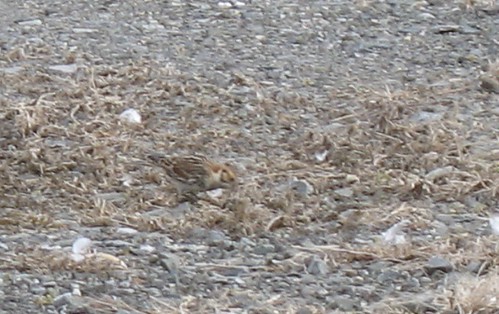
On this day in 1895, A. H. Phillips found two Lapland Longspurs in a flock of Snow Buntings at Princeton in Mercer County. Phillips collected one of the longspurs and provided the first confirmed evidence of the species' occurrence in NJ (Babson 1901, Stone 1908).
Unlike many birds with definite first state records, Lapland Longspur is a regularly occurring (albeit uncommon) part of NJ's avifauna, and was probably visiting the state long before the first specimen was taken. The longspurs are found both along the shore and inland, and the best advice for those who would like to add Lapland Longspur to their NJ list is to visit places known to draw flocks of Horned Larks and/or Snow Buntings, both frequent fellow travelers for the longspurs. This translates into barrier island beaches along the coast, inland farm fields at places like Alpha (Warren County), not to mention the gravel parking lot at Spruce Run Reservoir in Hunterdon County. Spruce Run was where I saw my first North American Lapland Longspur a couple of days ago; its (record shot only) photo appears above. More pics at my Flickr stream if you want; just scroll past the Roebling bridge photos.
For those familiar with the Princeton area today (and its general dearth of Snow Buntings, never mind longspurs), there might be some question as to where Phillips was so fortunate to find these birds. The answer may be in Babson's entry on Snow Buntings (or as they were called then, Snowflakes). This states that the winter of 1894-1895 was a good year for Snow Buntings because "several large flocks appeared at intervals during the winter." Babson also notes that none had been seen in the area since this noteworthy winter.
A further note about Phillips; he was a professor at Princeton University who taught Mineralogy but clearly had a strong ornithological avocation. Thanks to this page, I can also report that Phillips is commemorated in a "Faculty Song" at Princeton: "Ha Ha Phillips, he he he / Teaches mineralogy'." Apparently he liked to laugh.
Babson, William Arthur. 1901. The Birds of Princeton, New Jersey, and Vicinity. Bulletin of the Bird Club of Princeton University 1:7-82.
Subscribe to:
Posts (Atom)