On this day in 1929, C. Eliot Underdown spotted a Black Guillemot at the long jetty north of Cape May Harbor. The guillemot flew in from the northeast and landed in the water on the lee side of the jetty. Here it dove several times as Underdown viewed it from within 20 feet. The bird was in the expected mottled grayish winter plumage that makes the Black Guillemot's name an apparent misnomer at times.
Black Guillemot is the least common of the alcids that visit NJ waters in the winter. There are 12 state records to date, with most coming from Monmouth and Ocean Counties. There are three records for Cape May County, however. There is also an inland record from Boonton Reservoir in Morris County. The vast majority have been one-day wonders, but just last winter NJ birders were lucky enough to have a guillemot that lingered for over a month from early December 2005 to January of this year.
Underdown, C. Eliot. 1930. Black Guillemot (Cepphus grylle) at Cape May, N. J. Auk 47:242. PDF here
Sunday, December 10, 2006

Saturday, December 09, 2006
Ash-throated Flycatcher
On this day in 1984, an Ash-throated Flycatcher was found at Assunpink WMA in Monmouth County. Word did not get out for a couple of weeks, but the bird stayed until 9 January 1985, so many birders were able to see it (Boyle et al. 1985).
For a species with a relatively recent first state record, Ash-throated Flycatcher has quickly become an almost expected feature of NJ's avifauna. The lion's share of the 32 records to date are from the coast, most frequently Cape May. There are a mere handful of records from inland locations such as Assunpink (which got its second record of the species 12-16 November 2005). The December date of the first state record turns out to fall a little late seasonally; November is the month with the bulk of the records. Dates of occurrence run from 22 October to 12 January (no spring records), so Ash-throated Flycatcher demonstrates a marked season (although there are a few spring records from other Northeastern states). Many birds are one-day wonders, but some have lingered longer.
The relatively recent advent of NJ Ash-throated Flycatcher records is matched by nearby states: New York's first record was in 1970, Massachusetts' was in 1972 and Pennsylvania's was in 1997 (Levine 1998, McWilliams & Brauning 2000, Veit & Petersen 1993).
Boyle, William J., Jr., Robert O. Paxton, & David A. Cutler. 1985. The Winter Season, Hudson-Delaware Region. American Birds 39:150-154.
For a species with a relatively recent first state record, Ash-throated Flycatcher has quickly become an almost expected feature of NJ's avifauna. The lion's share of the 32 records to date are from the coast, most frequently Cape May. There are a mere handful of records from inland locations such as Assunpink (which got its second record of the species 12-16 November 2005). The December date of the first state record turns out to fall a little late seasonally; November is the month with the bulk of the records. Dates of occurrence run from 22 October to 12 January (no spring records), so Ash-throated Flycatcher demonstrates a marked season (although there are a few spring records from other Northeastern states). Many birds are one-day wonders, but some have lingered longer.
The relatively recent advent of NJ Ash-throated Flycatcher records is matched by nearby states: New York's first record was in 1970, Massachusetts' was in 1972 and Pennsylvania's was in 1997 (Levine 1998, McWilliams & Brauning 2000, Veit & Petersen 1993).
Boyle, William J., Jr., Robert O. Paxton, & David A. Cutler. 1985. The Winter Season, Hudson-Delaware Region. American Birds 39:150-154.
Saturday, December 02, 2006
Rock Wren
On this day in 1992, David Sibley found a Rock Wren at Cape May Point. One of the rarer Western strays to the Northeast, this bird settled in for a long stay and was seen by many. It was last seen 28 March 1993, after a spring blizzard.
There are few other Northeastern records of Rock Wren, but they show a strong seasonal pattern. Both of Massachusetts' Rock Wrens were coastal long-stayers; the first was found at Andrews Point in Rockport on 19 December 1965 and stayed until 25 January 1966. The second one appeared at South Orleans on 2 November 1991 and it remained until the middle of February 1992 (Veit and Petersen 1993). New York has a record from Fredonia in inland Chautauqua County on 29 November 1986. This bird only stayed until 3 December (Levine 1998). Maryland also has a mid-October record from coastal Worcester County (Iliff et al. 1996).
In other words, Rock Wrens are not as common as, say, the 10 Cave Swallows that were reported from Cape May today in the wake of our latest front, but they otherwise fit the overall pattern of late fall vagrants from the West.
There are few other Northeastern records of Rock Wren, but they show a strong seasonal pattern. Both of Massachusetts' Rock Wrens were coastal long-stayers; the first was found at Andrews Point in Rockport on 19 December 1965 and stayed until 25 January 1966. The second one appeared at South Orleans on 2 November 1991 and it remained until the middle of February 1992 (Veit and Petersen 1993). New York has a record from Fredonia in inland Chautauqua County on 29 November 1986. This bird only stayed until 3 December (Levine 1998). Maryland also has a mid-October record from coastal Worcester County (Iliff et al. 1996).
In other words, Rock Wrens are not as common as, say, the 10 Cave Swallows that were reported from Cape May today in the wake of our latest front, but they otherwise fit the overall pattern of late fall vagrants from the West.
Friday, November 17, 2006
Townsend's Solitaire
On this day in 1980, a Townsend's Solitaire was found at Sunrise Mountain in Sussex County by C. Wood and J. Climpson. The bird "was enjoyed by many as it fed on mountain ash berries through the period" (Paxton et al. 1981). This bird stayed until 14 December 1980. Interestingly, NJ's ninth record of Varied Thrush, another western thrush, arrived a few days earlier on 15 November in Allamuchy State Park in Warren County.
In another odd coincidence, NJ's third record of the solitaire was also at Sunrise Mountain on 15 November 1987. If these records had occurred in consecutive years, it would be tempting to think that they might refer to the same bird, but seven years apart is another matter. In total, NJ has five records of this thrush; the first three were from the northern part of the state, but the two most recent (including the popular long-staying bird in Heislerville, Cumberland County) have been from the coastal plain. The Heislerville bird was found on 27 December 1998 and proceeded to overwinter until 18 April 1999.
Other Northeastern states show a similar pattern of occurrence for Townsend's Solitaire; a mere scattering of records, almost all in the fall.
Paxton, Robert O., William J. Boyle, Jr., & David A. Cutler. 1981. The Autumn Migration, Hudson-Delaware Region. American Birds 35:162-166.
In another odd coincidence, NJ's third record of the solitaire was also at Sunrise Mountain on 15 November 1987. If these records had occurred in consecutive years, it would be tempting to think that they might refer to the same bird, but seven years apart is another matter. In total, NJ has five records of this thrush; the first three were from the northern part of the state, but the two most recent (including the popular long-staying bird in Heislerville, Cumberland County) have been from the coastal plain. The Heislerville bird was found on 27 December 1998 and proceeded to overwinter until 18 April 1999.
Other Northeastern states show a similar pattern of occurrence for Townsend's Solitaire; a mere scattering of records, almost all in the fall.
Paxton, Robert O., William J. Boyle, Jr., & David A. Cutler. 1981. The Autumn Migration, Hudson-Delaware Region. American Birds 35:162-166.
Monday, November 06, 2006
Brown-chested Martin
On this day in 1997, Paul Lehman was indulging in what has become a popular autumn Cape May pastime: sorting through flocks of swallows. Under optimal conditions, big swallow flocks can be found anywhere around the southern end of Cape Island; Lehman happened to be at the South Cape May Meadows. As he looked through a flock of 50 to 75 Tree Swallows, he spotted a martin. Any November martin would be highly unusual as virtually all Purple Martins leave the state by the end of September (Walsh et al. 1999). After a few seconds, the martin headed off toward Cape May Point State Park and Lehman returned home to check some books and get the word out to the locals. Further glimpses of the bird were had by various birders over the course of the afternoon, and the identification seemed to come down to a choice between Purple and Brown-chested Martins. The only previous confirmed North American record of Brown-chested Martin was a bird that was collected on Monomoy Island off Cape Cod in Massachusetts on 12 June 1983.
Lehman (1998) tells the story in detail: how after the first day of the martin's stay, local birders were left with the feeling that it was an odd Purple Martin. More research was done and out-of-state birders were consulted overnight. The locals were out in force the next morning, despite unpromising weather, and the martin was relocated on the west side of Cape May Point by the gingerbread church. The martin's companions included late Barn and Cliff Swallows, late Chimney Swifts and "as many as 5 Cave Swallows." The martin was determined to be a Brown-chested Martin and the twitch was on.
The martin was seen until 15 November, when it seemed to be in poor condition; it was not seen afterward and was presumed to have succumbed during the night. Before then, as many as a thousand birders may have participated in what one of my birding friends fondly remembers as "Martin Madness."
Lehman, Paul. 1998. Brown-chested Martin in Cape May!: First New Jersey and Second Documented North American Record. Records of New Jersey Birds 24:66-69.
Lehman (1998) tells the story in detail: how after the first day of the martin's stay, local birders were left with the feeling that it was an odd Purple Martin. More research was done and out-of-state birders were consulted overnight. The locals were out in force the next morning, despite unpromising weather, and the martin was relocated on the west side of Cape May Point by the gingerbread church. The martin's companions included late Barn and Cliff Swallows, late Chimney Swifts and "as many as 5 Cave Swallows." The martin was determined to be a Brown-chested Martin and the twitch was on.
The martin was seen until 15 November, when it seemed to be in poor condition; it was not seen afterward and was presumed to have succumbed during the night. Before then, as many as a thousand birders may have participated in what one of my birding friends fondly remembers as "Martin Madness."
Lehman, Paul. 1998. Brown-chested Martin in Cape May!: First New Jersey and Second Documented North American Record. Records of New Jersey Birds 24:66-69.
Wednesday, November 01, 2006
Boreal Owl
On this day in 1962, a Boreal Owl hit a building at Raritan Arsenal, near Bonhamtown, in Middlesex County. John Bull (1975) picks up the story by quoting a letter from Irving Black: "It was taken to the home of a boy, Joseph Mish (about 15),...and kept alive for about a week. After death it was buried carefully in a cloth. Before death there evidently had been no feeling that the bird was anything of interest, but later the boy kept pointing to illustrations of the Boreal Owl and insisted that was what his bird was. Because of this the bird was dug up in early February and brought to the Newark Museum." In what sounds like a sublime piece of understatement, Black's quote concludes, "It was in surprisingly good condition for a bird that had been dead three months."
NJ is not known for its abundance of irruptive northern owls apart from Short-eared Owls. This is the single accepted record of Boreal Owl for the state (there are two other reports). Pennsylvania has a single record of Boreal Owl from Allegheny County, about the same distance south as central NJ (McWilliams and Brauning 2000). If one wants to keep hope alive for future NJ Boreal Owl records, one can always look to the bird that showed up in Central Park a few years back. If a Boreal Owl can make it to Central Park, another can certainly find its way to NJ. At least, we can hope so.
NJ is not known for its abundance of irruptive northern owls apart from Short-eared Owls. This is the single accepted record of Boreal Owl for the state (there are two other reports). Pennsylvania has a single record of Boreal Owl from Allegheny County, about the same distance south as central NJ (McWilliams and Brauning 2000). If one wants to keep hope alive for future NJ Boreal Owl records, one can always look to the bird that showed up in Central Park a few years back. If a Boreal Owl can make it to Central Park, another can certainly find its way to NJ. At least, we can hope so.
Tuesday, October 17, 2006
Field Trip: Tuckerton Seaport

This is the first in an occasional series of posts about NJ's bird history. These "Field Trip" posts will involve actual gadding about in the Garden State, as opposed to merely sticking one's nose in a bird book.
Tuckerton Seaport may not be the greatest vagrant trap in the state, but there's plenty on hand to interest the historically-minded birder. Tuckerton Seaport is a project of the Barnegat Bay Decoy and Baymen's Museum. Recreated buildings such as a lighthouse, boat-builder's shop and hunting lodges (among others), line the waterway. Exhibits inside each building give information on the history of different industries and crafts on the Atlantic bayshore of NJ. There are also docents and crafters demonstrating pursuits such as decoy-carving and boat-building.
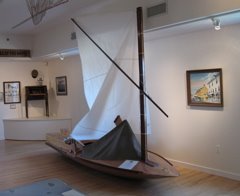
The Barnegat Bay area is the home of the sneakbox, a unique craft intended for waterfowling. The boat's shallow draft makes for a stable craft that is at home navigating bayside marshes, even in shallow water. Its low profile (combined with camouflaging techniques, such as tying bunches of marsh grass onto the boat's deck) makes it easier for hunters to sneak up on their quarry. It can be rowed or sailed; it can also take an outboard motor on the stern.

One building of interest is the recreation of the Hester Sedge Gun Club, which is intended to show a typical hunting "shack" from the 1940s. Among other fixtures, it has a "punt" or market gun hanging on the wall. Punts were outlawed with the passage of the National Migratory Bird Act in 1918, but they were the favored weaponry of market gunners before then.
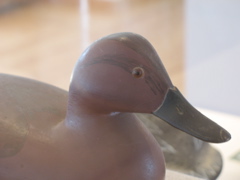
Like it or not, much of the avian history chronicled at Tuckerton Seaport involves hunting. Even decoys, often considered innocuous decorative items, were originally intended to be tools used to hunt birds more effectively. In addition to decoy carvers demonstrating their skills at the Seaport, a collection of decoys is housed in a recreation of the Marshelder Gun Club. One of the decoys on display is this Cinnamon Teal carved by John Updike (not the novelist) of Green Bank. Since Cinnamon Teal is a Review List species in NJ, I found myself pondering a records committee circulation that included a decoy among the documentation. But I digress.
Tuckerton Seaport is open daily to the end of October, then on weekends until 18 December. The spring season starts in May. In addition to its exhibits, the Seaport offers classes in decoy-carving and other crafts.
Saturday, October 14, 2006
Sabine's Gull

On this day in 1979, a Sabine's Gull was found on a pelagic trip 24 miles off Cape May by Stuart Keith, Bill Boyle and the proverbial "m.obs."
Gulls have a bad reputation among birders. The complexity of identification issues, particularly in the "large white-headed gull" complex, is enough to drive one to drink. Against this background, the Sabine's Gull is refreshing. It has big white triangles in the wings in all plumages, a mark that should make any birder take notice if he or she is fortunate enough to encounter this gull. It is most commonly found in the fall. Ironically,I saw my lifer Sabine's Gull on this day in 2000; that was a bird that hung around Merrill Creek Reservoir in Warren County 8-15 October 2000.
Massachusetts is the center of Sabine's Gull records in the Northeast; due in large part to over 75 fall records in the state, Sabine's Gull is not a Review List species in Massachusetts. Fall records are regular enough in New York State that they are not subject to review, either. However, New Jersey has only 15 state records in total. Four of the NJ records are of spring birds. The vast majority of NJ Sabine's Gull records come from coastal regions, but the Merrill Creek bird shows that inland records are not impossible.
Friday, October 13, 2006
Awfully Quiet 'Round Here
I apologize for the recent dearth of commentary on this blog. I recently started a new job, and that has claimed a certain measure of my time and energy (i.e., I can't hang around the house all day with my nose in bird books any more). But I think I'm back and besides, November is on its way. You want lots of first NJ state records, November is definitely your month.
A interesting report from the birding lists today is of a briefly-seen Sulphur-bellied Flycatcher in (where else?) Cape May. Now that would be quite a first state record! Massachusetts had one on Martha's Vineyard on 12-13 November 1983, so it is not quite unknown in the Northeast (Veit & Peterson 1993).
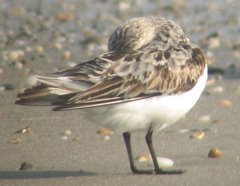
The Sanderling in the photo isn't hiding its head due to lack of blogging embarrassment, it's just taking a nap on the beach at the South Cape May Meadows (or it was on 6 September). It shows a combination of worn feathers and brand-new ones, a real illustration of molt in action.
Sunday, October 01, 2006
Resources
I've just revamped my links section somewhat. I'll take that as an excuse to expand on some of the links in the "Reference" section.
Birdmail (aka "Siler's page") is probably known to every active birder. It provides a way to keep up with the birding mailing lists in places both near and far. There's even a section for those of us who've gotten distracted by bugs.
Searchable Ornithological Research Archive (SORA) has been an invaluable boon to this blog so far, and I don't expect that to change. Here you can search the back issues of ornithological journals such as the Auk, Wilson Bulletin, Condor, Western Birds and others. This is a terrific online resource because runs of these journals are not always easily found. Making them available online for the use of researchers is one of the things that adds value to the internet. I encourage every reader of this blog to visit SORA and explore the archives. You're sure to find some intriguing information there.
Ornithological Books Online is a collection of links to, well, ornithological books online. This page can lead you to John James Audubon and Alexander Wilson's works (although some of the links may be outdated). A good adjunct to this is the new Google book search, which has started adding some older (i.e., public domain) works in their entirety. Several of Frank M. Chapman's books, such as Handbook of Birds of Eastern North America and Bird-Lore, can be found at Google.
Finally, we have an edited version of Arthur C. Bent's Life Histories of North American Birds. Although some of this information has been superceded by more recent research, these vignettes often provide a vivid look at bird behavior. These accounts also provide a different model of scientific writing than we are accustomed to today; the reports that Bent quotes are almost chatty by modern standards.
I'm sure that the links section will grow in the future, but that's the "Reference" section for the moment.
Birdmail (aka "Siler's page") is probably known to every active birder. It provides a way to keep up with the birding mailing lists in places both near and far. There's even a section for those of us who've gotten distracted by bugs.
Searchable Ornithological Research Archive (SORA) has been an invaluable boon to this blog so far, and I don't expect that to change. Here you can search the back issues of ornithological journals such as the Auk, Wilson Bulletin, Condor, Western Birds and others. This is a terrific online resource because runs of these journals are not always easily found. Making them available online for the use of researchers is one of the things that adds value to the internet. I encourage every reader of this blog to visit SORA and explore the archives. You're sure to find some intriguing information there.
Ornithological Books Online is a collection of links to, well, ornithological books online. This page can lead you to John James Audubon and Alexander Wilson's works (although some of the links may be outdated). A good adjunct to this is the new Google book search, which has started adding some older (i.e., public domain) works in their entirety. Several of Frank M. Chapman's books, such as Handbook of Birds of Eastern North America and Bird-Lore, can be found at Google.
Finally, we have an edited version of Arthur C. Bent's Life Histories of North American Birds. Although some of this information has been superceded by more recent research, these vignettes often provide a vivid look at bird behavior. These accounts also provide a different model of scientific writing than we are accustomed to today; the reports that Bent quotes are almost chatty by modern standards.
I'm sure that the links section will grow in the future, but that's the "Reference" section for the moment.
Tuesday, September 26, 2006
Le Conte's Sparrow
On this day in 1976, a Le Conte's Sparrow was found at Tuckerton in Ocean County by Richard Ryan, K. Richards, and Frank and Barb Haas; the bird stayed until 2 October and many others also saw it. This species, one of the skulking Ammodramus sparrows, has seen a marked upsurge in the Northeast in recent decades; at least some of this has to be due to the fact that there are more observers in the field, and more knowledge about identifying Le Conte's Sparrows. New York has a specimen record from 1897 near Ithaca, so the species is not a newcomer to the region (Levine 1998). It will always be a challenge for an observer to find a Le Conte's Sparrow, however, whether the birding technology of choice is optical equipment or a shotgun.
Of NJ's 24 records so far, 20 have come since 1990. Other Northeastern states show a similar temporal pattern. Although Cape May has seven Le Conte's records, Monmouth County has nine, helped in large part by the north end of Sandy Hook. The first state record was a tad early, as it turned out; about 50 percent of NJ Le Conte's records come from October. So get out your field guides and study up; both Grasshopper Sparrow and Sharp-tailed Seaside Sparrow bear a passing resemblance to Le Conte's Sparrow.
Levine, Emanuel. 1998. Bull's Birds of New York State. Comstock, Ithaca, NY.
Of NJ's 24 records so far, 20 have come since 1990. Other Northeastern states show a similar temporal pattern. Although Cape May has seven Le Conte's records, Monmouth County has nine, helped in large part by the north end of Sandy Hook. The first state record was a tad early, as it turned out; about 50 percent of NJ Le Conte's records come from October. So get out your field guides and study up; both Grasshopper Sparrow and Sharp-tailed Seaside Sparrow bear a passing resemblance to Le Conte's Sparrow.
Levine, Emanuel. 1998. Bull's Birds of New York State. Comstock, Ithaca, NY.
Monday, September 25, 2006
Anhinga
On this day in 1971, an Anhinga was seen at Cape May by K. Berlin, B. Baumann and others. The bird was soaring with Broad-winged Hawks, an unusual sight in NJ but not so out of the ordinary in places like Hazel Bazemore Hawkwatch in Corpus Christi, Texas.
Many first state records set a pattern which is reinforced by later records of the species. Not so Anhinga. The first record was a fall bird, but it took until 2005 to get another fall record of the species. That makes two fall records out of 13 total Anhinga records, so far. An oddity is a dead Anhinga found 16 January 1989 in Whiting, Ocean County. The spring records range from 24 April to 27 June, with five in May.
Anhingas are notorious for being fly-over birds that can never be relocated. These fly-overs usually leave little time for observation, which raises the odds for misidentification. A fly-over bird usually can't be independently confirmed by other birders, either, which adds to the frustration. Some species have a reputation for being "one-day wonders" but Anhingas might be "five-minute wonders." Jersey birders who've done time in Florida might be particularly frustrated, since Anhingas are so cooperative down there.
Many first state records set a pattern which is reinforced by later records of the species. Not so Anhinga. The first record was a fall bird, but it took until 2005 to get another fall record of the species. That makes two fall records out of 13 total Anhinga records, so far. An oddity is a dead Anhinga found 16 January 1989 in Whiting, Ocean County. The spring records range from 24 April to 27 June, with five in May.
Anhingas are notorious for being fly-over birds that can never be relocated. These fly-overs usually leave little time for observation, which raises the odds for misidentification. A fly-over bird usually can't be independently confirmed by other birders, either, which adds to the frustration. Some species have a reputation for being "one-day wonders" but Anhingas might be "five-minute wonders." Jersey birders who've done time in Florida might be particularly frustrated, since Anhingas are so cooperative down there.
Saturday, September 23, 2006
Black-throated Gray Warbler
On this day in 1956, W. Parker, Ed Bloor and Charles Rogers found a Black-throated Gray Warbler at Tuckerton in Ocean County.
September is the peak month in NJ and most nearby states for this dapper-looking Western stray. NJ has 19 records of the species at this writing, nine of which are September records. Two-thirds of these occur in the span between 20 September and the end of the month. Most of the rest of the state's records come from fall, going into December in two cases; there are a couple of "early" records for August as well. There are only two spring records. In other words, this species shows a temporal pattern typical of a Western vagrant, although its occurrence peaks earlier in the season than the many Western species that have made November a month to be reckoned with for rarity-chasers.
No fewer than four individuals have been banded at Island Beach State Park in Ocean County, while there are seven accepted records from Cape May (and Sibley 1997 lists two more reports) (Hanson 2002-2003). Although at first glance, the species shows up in the expected coastal vagrant traps, there are also six inland records scattered across the state from Franklin in Sussex County to Mickleton in Gloucester County. One real oddity is that the species has never been recorded at Sandy Hook, which would seem like an obvious site for it to turn up.
Black-throated Gray Warbler is not quite annual in NJ, but it is a regular rarity, so most birders will get a chance to chase one sooner rather than later.
Hanson, Jennifer W. 2002-2003. The Status of Black-throated Gray and Townsend's Warblers in New Jersey. Records of New Jersey Birds 28:24-78.
Sibley, David. 1997. The Birds of Cape May. New Jersey Audubon Society, Bernardsville, NJ. Second edition.
September is the peak month in NJ and most nearby states for this dapper-looking Western stray. NJ has 19 records of the species at this writing, nine of which are September records. Two-thirds of these occur in the span between 20 September and the end of the month. Most of the rest of the state's records come from fall, going into December in two cases; there are a couple of "early" records for August as well. There are only two spring records. In other words, this species shows a temporal pattern typical of a Western vagrant, although its occurrence peaks earlier in the season than the many Western species that have made November a month to be reckoned with for rarity-chasers.
No fewer than four individuals have been banded at Island Beach State Park in Ocean County, while there are seven accepted records from Cape May (and Sibley 1997 lists two more reports) (Hanson 2002-2003). Although at first glance, the species shows up in the expected coastal vagrant traps, there are also six inland records scattered across the state from Franklin in Sussex County to Mickleton in Gloucester County. One real oddity is that the species has never been recorded at Sandy Hook, which would seem like an obvious site for it to turn up.
Black-throated Gray Warbler is not quite annual in NJ, but it is a regular rarity, so most birders will get a chance to chase one sooner rather than later.
Hanson, Jennifer W. 2002-2003. The Status of Black-throated Gray and Townsend's Warblers in New Jersey. Records of New Jersey Birds 28:24-78.
Sibley, David. 1997. The Birds of Cape May. New Jersey Audubon Society, Bernardsville, NJ. Second edition.
Friday, September 22, 2006
Cassin's Sparrow
On this day in 1961, a Cassin's Sparrow was netted and collected by Mabel Warburton at Island Beach State Park as part of Operation Recovery. The specimen ultimately went to the American Museum of Natural History in New York to have the identification confirmed. It was aged as an immature (Swinebroad 1966).
Cassin's Sparrow is a very rare vagrant in the East; there are a few records for the Midwest. One bird made it all the way to Seal Island, Nova Scotia in 1974; that was a spring bird (Tufts 1986). More recently, another turned up at Jones Beach State Park in New York in early October 2000. Two birds scarcely make a pattern of occurrence, of course. It is tempting to speculate, however, that if NJ ever gets another Cassin's Sparrow, a place like Sandy Hook would be as good as any for it to touch down.
Swinebroad, Jeff. 1966. Cassin's Sparrow in New Jersey. Auk 83:129. PDF here
Tufts, Robie W. 1986. Birds of Nova Scotia. Nimbus/Nova Scotia Museum, Halifax, Nova Scotia. Third edition.
Cassin's Sparrow is a very rare vagrant in the East; there are a few records for the Midwest. One bird made it all the way to Seal Island, Nova Scotia in 1974; that was a spring bird (Tufts 1986). More recently, another turned up at Jones Beach State Park in New York in early October 2000. Two birds scarcely make a pattern of occurrence, of course. It is tempting to speculate, however, that if NJ ever gets another Cassin's Sparrow, a place like Sandy Hook would be as good as any for it to touch down.
Swinebroad, Jeff. 1966. Cassin's Sparrow in New Jersey. Auk 83:129. PDF here
Tufts, Robie W. 1986. Birds of Nova Scotia. Nimbus/Nova Scotia Museum, Halifax, Nova Scotia. Third edition.
Saturday, September 16, 2006
Black-capped Petrel
On this day in 1991, a pelagic trip to the Hudson Canyon found NJ's first Black-capped Petrel. NY also claims this bird, which may have been a result of the passage of Hurricane Bob. NY has the most records of this species for the local region, and most of those are also related to the passage of hurricanes (Levine 1998). One of Massachusetts' records was also during Bob, a bird off Eastham on Cape Cod (Veit & Petersen 1993). Black-capped Petrels regularly range northward in the Gulf Stream as far as North Carolina, so they are to be looked for on pelagic trips, whether or not hurricanes are involved.
NJ's only other record of Black-capped Petrel was a total of eight seen in off the Concrete Ship in Cape May during an afternoon seawatch after the passage of Hurricane Bertha on 13 July 1996 (NJ Hotline of 17 July 1996).
Levine, Emanuel. 1998. Bull's Birds of New York State. Comstock, Ithaca, NY.
Veit, Richard R., & Wayne R. Petersen. 1993. Birds of Massachusetts. Massachusetts Audubon Society, Lincoln, MA.
NJ's only other record of Black-capped Petrel was a total of eight seen in off the Concrete Ship in Cape May during an afternoon seawatch after the passage of Hurricane Bertha on 13 July 1996 (NJ Hotline of 17 July 1996).
Levine, Emanuel. 1998. Bull's Birds of New York State. Comstock, Ithaca, NY.
Veit, Richard R., & Wayne R. Petersen. 1993. Birds of Massachusetts. Massachusetts Audubon Society, Lincoln, MA.
Friday, September 15, 2006
Bell's Vireo
On this day in 1959, a Bell's Vireo was netted by Mr. and Mrs. Albert Schnitzler and subsequently collected by Joseph Jehl, Jr., at Island Beach State Park in Ocean County (Jehl 1960). That bird, an immature female, was found just ten days before another Bell's Vireo was caught and banded a little to the north at Tiana Beach near Shinnecock Inlet on Long Island, New York (Bull 1975). Prior to these records, the only other unequivocal Eastern record was a bird taken on 11 November 1897 in Durham, New Hampshire (Jehl 1960).
There was a gap between this first record and more recent ones, which started in 1994. All four of the recent records come that rarity vortex, Cape May. One of these birds occurred exactly 39 years to the day after the first state record, but the others have come later in fall. One appeared for a few days in October-November 1994; the other two stayed for a month from December into January (one in 1996-1997 and one in 2001-2002).
Bell's Vireo is one of the more uncommon western strays; New Jersey and New York have the most records in the region. There are a number of sight reports, but this species must be identified with care.
Bull, John. 1975. Birds of the New York Area. Dover, New York, NY.
Jehl, Joseph R., Jr. 1960. Bell's Vireo in New Jersey. Wilson Bulletin 72:404. PDF here
There was a gap between this first record and more recent ones, which started in 1994. All four of the recent records come that rarity vortex, Cape May. One of these birds occurred exactly 39 years to the day after the first state record, but the others have come later in fall. One appeared for a few days in October-November 1994; the other two stayed for a month from December into January (one in 1996-1997 and one in 2001-2002).
Bell's Vireo is one of the more uncommon western strays; New Jersey and New York have the most records in the region. There are a number of sight reports, but this species must be identified with care.
Bull, John. 1975. Birds of the New York Area. Dover, New York, NY.
Jehl, Joseph R., Jr. 1960. Bell's Vireo in New Jersey. Wilson Bulletin 72:404. PDF here
Thursday, September 14, 2006
Spotted Redshank
On this day in 1978, C. Clark and P. Fahey found a Spotted Redshank at Brigantine NWR. This bird remained until 28 September 1978, then moved on, but it returned the following year from 28 September to 8 October 1979. The only other record of Spotted Redshank in NJ is from 22-23 October 1993, also at Brig. The most notorious "Spotted Redshank" in NJ birding history, however, might be the 1973 Brig bird that turned out to be an oiled Greater Yellowlegs (Kaufman 1997, Smith 1974).
Mlodinow (1999) gives an extensive account of Spotted Redshank occurrence in North America. By far the most records come from the Aleutians, but eastern North America has quite a few as well. Mlodinow suggests that eastern Spotted Redshanks may come across the continent, ultimately originating in Asia.
This species' showy black alternate plumage is briefly held, so that birders hoping for a redshank in NJ are best advised to scrutinize yellowlegs carefully.
Kaufman, Kenn. 1997. Kingbird Highway. Houghton Mifflin, Boston, MA.
Mlodinow, Steven G. 1999. Spotted Redshank and Common Greenshank in North America. North American Birds 53:124-130.
Smith, P. William, Jr. 1974. Spotted Redshank Vs. Soiled Yellowlegs. Birding 6:84-86.
Mlodinow (1999) gives an extensive account of Spotted Redshank occurrence in North America. By far the most records come from the Aleutians, but eastern North America has quite a few as well. Mlodinow suggests that eastern Spotted Redshanks may come across the continent, ultimately originating in Asia.
This species' showy black alternate plumage is briefly held, so that birders hoping for a redshank in NJ are best advised to scrutinize yellowlegs carefully.
Kaufman, Kenn. 1997. Kingbird Highway. Houghton Mifflin, Boston, MA.
Mlodinow, Steven G. 1999. Spotted Redshank and Common Greenshank in North America. North American Birds 53:124-130.
Smith, P. William, Jr. 1974. Spotted Redshank Vs. Soiled Yellowlegs. Birding 6:84-86.
Long-billed Curlew
On this day in 1880, Dr. W. L. Abbott shot a Long-billed Curlew on Five Mile Beach in Cape May County. This barrier island currently hosts the Wildwoods.
Stone (1965) said the Cape May gunners called it the Sickle-bill. In Absecon, Pleasantville and Somers Point they called it Buzzard Curlew. The Pleasantville gunners also inclined towards naming it Smoker, Old Smoker or Lousy-bill; in Cape May Court House, it was Mowyer. Perhaps the Tuckerton gunners had a line in to the AOU when they called it Long-billed Curlew (Trumbull 1888).
In other words, Abbott's curlew may have been the first state record reviewed and accepted by the NJBRC (the specimen currently resides at the Academy of Natural Sciences in Philadelphia), but it was not the true first state record. The Long-billed Curlew was one of the shorebirds that was favored by market gunners and, as a result, almost shot out of existence. The Eskimo Curlew was another casualty of this profession. Alexander Wilson wrote about the regular migrations of the species through NJ in mid-May and September; he wrote in 1812. By the time W. E. D. Scott visited Long Beach in April 1877, he considered it "very rare," not to mention "shy" (Stone 1965). I guess the prospect of gunplay might make anyone shy.
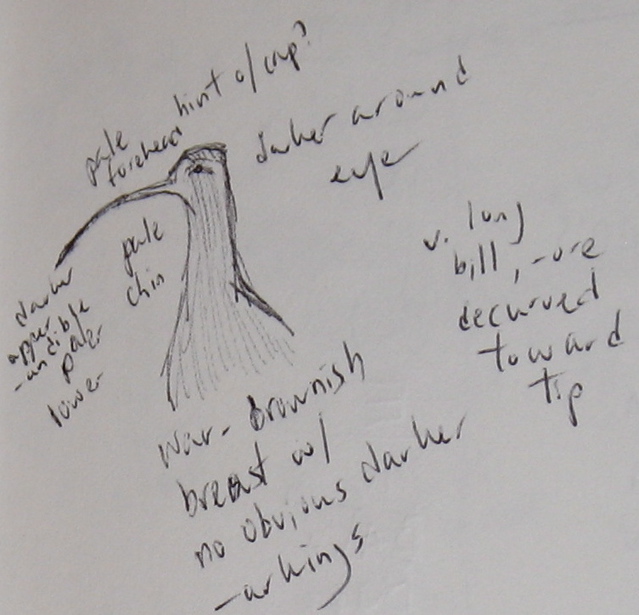
Almost 100 years passed between another record from Five Mile Beach in 1898 and a record from Cape May in 1987. In the late 1980s, I found birding. I developed a fascination with shorebirds, looked at field guides and thought seeing a Long-billed Curlew would be a really neat thing. I was sure I'd have to go out west to accomplish the feat, but I was wrong. My lifer Long-billed Curlew was the one that showed up in North Wildwood (a slice of bayside on Five Mile Beach) in 2002. As remarkable as this overwintering curlew was, more remarkable was its return the following year. Then there was the one that visited an airport in Whiting, in the Pine Barrens, during the day, then lit out toward Toms River in the evening. I saw that one too (the sketch that illustrates this post is of the North Wildwood curlew).
Neighboring states tell a similar story of the Long-billed Curlew; formerly abundant, then shot out by market gunners. Long Island seems to have been another favored location (Levine 1998). It still winters in the Southeast, but NJ's current birders have been very fortunate in the recent pulse of Long-billed Curlew records. May there be more to come.
Levine, Emanuel. 1998. Bull's Birds of New York State. Comstock, Ithaca, NY.
Stone, Witmer. 1965. Bird Studies at Old Cape May: An Ornithology of Coastal New Jersey. Dover, New York, NY.
Trumbull, Gurdon. 1888. Names and Portraits of Birds Which Interest Gunners. Harper & Brothers, New York, NY.
Saturday, September 09, 2006
Lesser Black-backed Gull
On this day in 1934, Charles Urner and James L. Edwards found a Lesser Black-backed Gull at Beach Haven in Ocean County. Not only was this bird a first for NJ, it was the first North American record outside of Greenland (Edwards 1935, Post & Lewis 1995).
More records of this species accumulated, at first slowly but then more quickly, so that the Lesser Black-backed Gull is now a regular part of NJ's avifauna. Walsh et al. (1999) give a high count of 53 birds at Florence in Burlington County on 20 March 1997. Florence, of course, is just across the Delaware River from the massive Tullytown dump in Pennsylvania, a location that concentrates gulls. That high count has since been eclipsed on more than one occasion; the current state high count of Lesser Black-backed Gulls was made by Ward Dasey at Florence on 15 November 2003 and amounted to 214+ birds (Driver 2004). As numbers have increased, so have sightings of immature birds, and records can now be found throughout the year, even during the summer. It seems probable that this species must nest somewhere in North America, but there is still no hard proof. Sightings have increased across the country, but the East Coast is still this species' stronghold.
Walsh et al. state that southward-bound migrants occur "early in the fall, usually by mid-September." This fits perfectly with the date of the first record. Although graellsii of western Europe is the expected subspecies, Edwards' description of the first NJ bird states that the bird's back color appeared to be the same as that of Great Black-backed Gulls nearby; the observers circled the bird to make sure that the angle of the light was not affecting the bird's appearance. As a result, the observers thought that the subspecies involved was fuscus, which is native to northern Scandinavia. Adult birds of the subspecies intermedius, which occurs further south in Scandinavia, also have a black mantle, while adult graellsii birds have a slaty mantle that contrasts with black wingtips. Today's birders also have to consider the so-called "Dutch intergrades" between graellsii and intermedius when confronted by a Lesser Black-backed Gull with a darker-than-normal mantle (Post & Lewis 1995). Light conditions and the angle of the bird respective to the observer can also make dramatic differences in the apparent shade of a gull's mantle.
As anyone who has dabbled in gull identification knows, it is often a frustrating pursuit. However, I still find that a day with an elegant, long-winged Lesser Black-backed Gull on the list is a good day in the field.
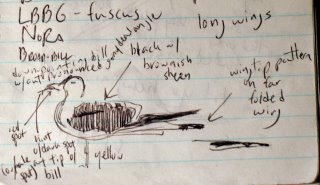
(Illustrative disclaimer: these field notes were not taken in NJ. They were actually taken at the Kuusamo dump in Finland, and they attempt to depict an adult fuscus Lesser Black-back.)
Driver, Paul J. 2004. 2003 Fall Field Notes, Region 4. New Jersey Birds 30:15-18.
Edwards, James L. 1935. The Lesser Black-backed Gull in New Jersey. Auk 52:85. PDF here
Post, Peter W., & Robert H. Lewis. 1995. The Lesser Black-backed Gull in the Americas: Occurrence and Subspecific Identity. Birding 27:282-290; 370-380.
Walsh, Joan, Vince Elia, Rich Kane, & Thomas Halliwell. 1999. Birds of New Jersey. New Jersey Audubon Society, Bernardsville, NJ.
More records of this species accumulated, at first slowly but then more quickly, so that the Lesser Black-backed Gull is now a regular part of NJ's avifauna. Walsh et al. (1999) give a high count of 53 birds at Florence in Burlington County on 20 March 1997. Florence, of course, is just across the Delaware River from the massive Tullytown dump in Pennsylvania, a location that concentrates gulls. That high count has since been eclipsed on more than one occasion; the current state high count of Lesser Black-backed Gulls was made by Ward Dasey at Florence on 15 November 2003 and amounted to 214+ birds (Driver 2004). As numbers have increased, so have sightings of immature birds, and records can now be found throughout the year, even during the summer. It seems probable that this species must nest somewhere in North America, but there is still no hard proof. Sightings have increased across the country, but the East Coast is still this species' stronghold.
Walsh et al. state that southward-bound migrants occur "early in the fall, usually by mid-September." This fits perfectly with the date of the first record. Although graellsii of western Europe is the expected subspecies, Edwards' description of the first NJ bird states that the bird's back color appeared to be the same as that of Great Black-backed Gulls nearby; the observers circled the bird to make sure that the angle of the light was not affecting the bird's appearance. As a result, the observers thought that the subspecies involved was fuscus, which is native to northern Scandinavia. Adult birds of the subspecies intermedius, which occurs further south in Scandinavia, also have a black mantle, while adult graellsii birds have a slaty mantle that contrasts with black wingtips. Today's birders also have to consider the so-called "Dutch intergrades" between graellsii and intermedius when confronted by a Lesser Black-backed Gull with a darker-than-normal mantle (Post & Lewis 1995). Light conditions and the angle of the bird respective to the observer can also make dramatic differences in the apparent shade of a gull's mantle.
As anyone who has dabbled in gull identification knows, it is often a frustrating pursuit. However, I still find that a day with an elegant, long-winged Lesser Black-backed Gull on the list is a good day in the field.
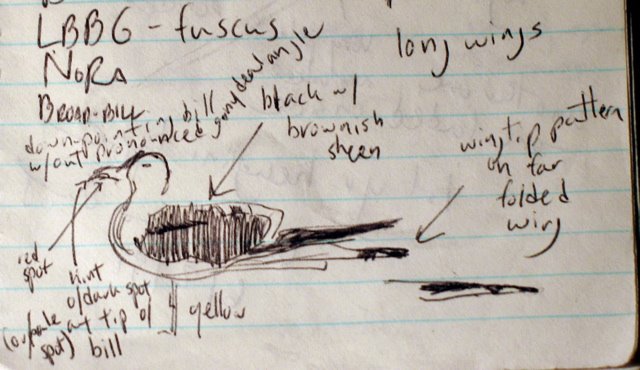
(Illustrative disclaimer: these field notes were not taken in NJ. They were actually taken at the Kuusamo dump in Finland, and they attempt to depict an adult fuscus Lesser Black-back.)
Driver, Paul J. 2004. 2003 Fall Field Notes, Region 4. New Jersey Birds 30:15-18.
Edwards, James L. 1935. The Lesser Black-backed Gull in New Jersey. Auk 52:85. PDF here
Post, Peter W., & Robert H. Lewis. 1995. The Lesser Black-backed Gull in the Americas: Occurrence and Subspecific Identity. Birding 27:282-290; 370-380.
Walsh, Joan, Vince Elia, Rich Kane, & Thomas Halliwell. 1999. Birds of New Jersey. New Jersey Audubon Society, Bernardsville, NJ.
Friday, September 08, 2006
Brown Noddy
On this day in 1979, NJ got its first (and so far only) record of Brown Noddy. The bird was seen in Cape May by Pete Dunne, Dave Ward, R. Gardner and others in the wake of Hurricane David. Other David birds included nine records of Sooty Terns on 6 September 1979 (stretching from Cape May to Wyckoff in Bergen County) and a Bridled Tern in Cape May on 7 September 1979.
Subscribe to:
Posts (Atom)