On this day in 1926, a storm hit Cape May. A concrete ship hulk, which had been intended to find its final harbor as part of a ferry dock, broke away from its moorings in the storm and ran aground not far off Sunset Beach. The ship could not be salvaged afterward and has been crumbling into the sea ever since.
Though the idea of a concrete ship seems to defy the laws of physics, a number of these vessels were built during World War I and II. The S. S. Atlantus was seaworthy enough to bring troops home from Europe and transport coal in New England after she left her home port of Brunswick, Georgia, in December 1918. She was retired in 1920, only to be resurrected by the prospect of a ferry service connecting Cape May with Delaware. Then the storm put paid to that notion. It wasn't until 1964 that Cape May-Lewes ferry service finally became a reality.
After the S. S. Atlantus ran aground, she became a curiosity for tourists and a landmark for birders. The concrete ship took her place among the birding topography of Cape May along with the bunker, the magnesite plant, and the beanery. She became known as a good place for a seawatch, and a good spot for Great Cormorant, Purple Sandpiper, or staging migrant Red-throated Loons (in the appropriate season). Unfortunately, she continues to decay into the bay; I guess it's a mark of the time that I've spent birding that the concrete ship is obviously reduced from what she was when I first met her.
For lots more about concrete ships in general, see the concrete ships site. The S. S. Atlantus is also given her own page there. For the stop-and-go history of ferry service between Cape May and Delaware, see the history page on the official Cape May-Lewes ferry site.
Rest in peace, S. S. Atlantus. We'll miss you when you're gone.
Showing posts with label "cape may county". Show all posts
Showing posts with label "cape may county". Show all posts
Tuesday, June 08, 2010


Friday, December 04, 2009
Ivory Gull Link Roundup
I'm tempted to designate the Ivory Gull the Official Patron Bird of this blog. In a post on 3 February 2007 (the anniversary of the first state record of a dead bird picked up in 1940), I typed the following:
"...the steady increase in climate warming suggests that this [Ivory Gull] is one of the least likely vagrants to visit NJ in the future."
By the end of the month, there was an Ivory Gull in Piermont, NY, not quite in NJ but close enough for regret.
Then, at the beginning of this year, there were two Ivory Gulls in Massachusetts, a circumstance that led to me doing my assigned reading for that week of classes in the back seat of a small car hurtling toward Plymouth. I had to get my homework done, of course, but an Ivory Gull as close as Massachusetts was too good to pass up (especially when I was able to add a visit to a cemetery of genealogical interest into the bargain, but that's another story). That experience led to the first installment of the current blog series on Bird Documentation in the Digital Age.
So now Cape May has finally gotten its Ivory Gull, which had the impeccable timing of arriving for Thanksgiving (though it seems to prefer fish heads to turkey on the menu). This is one occasion where I don't mind being wrong. In fact, in order to properly celebrate, I am posting a link roundup of Cape May Ivory Gull sightings in cyberspace. I hope to keep this post updated, and I'm sure I've missed something, so feel free to drop me a line at ammodramus88 residing at gmail.com if you would like to add something I've overlooked. And good luck to everyone looking for the gull over the weekend!
Ongoing coverage is on the blog at CMBO's website, but individual posts don't have permalinks, so I'm posting a general link to the blog. Another Cape May site with Ivory Gull pix is Bob Fogg's keekeekerr.com.
Ivory Gull newspaper coverage
(or, more accurately, online coverage from newspaper sites)
Cape May Times photo essay
Ivory Gull vids
"aburdo" vid
Benjamin Clock Ivory Gull foraging
Ray Duffy vid 1 vid 2
Ivory Gull photos
(if there are more than five photos from a particular photographer posted on Flickr or a similar site, I've just posted a general link to the photographer's online photo page. Screen names are in quotes.)
various photographers gallery on CMBO site
"Birding At Night" photo 1 photo 2 photo 3 photo 4 photo 5
"bluedasher" Flickr set
Devin Bosler photo 1 photo 2
Peter Burke photo 1 photo 2
Steve Byland photo
J. B. Churchill photo
Benjamin Clock photo 1 photo 2
Dave Czaplak Flickr set
Jeff Davis photos
Joe Delesantro Flickr set
Gerry Dewaghe PBase set
"donna lynn" photo
Ray Duffy photo

"...the steady increase in climate warming suggests that this [Ivory Gull] is one of the least likely vagrants to visit NJ in the future."
By the end of the month, there was an Ivory Gull in Piermont, NY, not quite in NJ but close enough for regret.
Then, at the beginning of this year, there were two Ivory Gulls in Massachusetts, a circumstance that led to me doing my assigned reading for that week of classes in the back seat of a small car hurtling toward Plymouth. I had to get my homework done, of course, but an Ivory Gull as close as Massachusetts was too good to pass up (especially when I was able to add a visit to a cemetery of genealogical interest into the bargain, but that's another story). That experience led to the first installment of the current blog series on Bird Documentation in the Digital Age.
So now Cape May has finally gotten its Ivory Gull, which had the impeccable timing of arriving for Thanksgiving (though it seems to prefer fish heads to turkey on the menu). This is one occasion where I don't mind being wrong. In fact, in order to properly celebrate, I am posting a link roundup of Cape May Ivory Gull sightings in cyberspace. I hope to keep this post updated, and I'm sure I've missed something, so feel free to drop me a line at ammodramus88 residing at gmail.com if you would like to add something I've overlooked. And good luck to everyone looking for the gull over the weekend!
Ongoing coverage is on the blog at CMBO's website, but individual posts don't have permalinks, so I'm posting a general link to the blog. Another Cape May site with Ivory Gull pix is Bob Fogg's keekeekerr.com.
Ivory Gull newspaper coverage
(or, more accurately, online coverage from newspaper sites)
Cape May Times photo essay
Ivory Gull trip reports
Ivory Gull vids
"aburdo" vid
Benjamin Clock Ivory Gull foraging
Ray Duffy vid 1 vid 2
Ivory Gull photos
(if there are more than five photos from a particular photographer posted on Flickr or a similar site, I've just posted a general link to the photographer's online photo page. Screen names are in quotes.)
various photographers gallery on CMBO site
"Birding At Night" photo 1 photo 2 photo 3 photo 4 photo 5
"bluedasher" Flickr set
Devin Bosler photo 1 photo 2
Peter Burke photo 1 photo 2
Steve Byland photo
J. B. Churchill photo
Benjamin Clock photo 1 photo 2
Dave Czaplak Flickr set
Jeff Davis photos
Joe Delesantro Flickr set
Gerry Dewaghe PBase set
"donna lynn" photo
Ray Duffy photo
Sam Galick photo
Jim Gilbert photo 1 photo 2 photo 3 photo 4
Steve Glynn photo
Jennifer W. Hanson (bad) photos
"ingret9" Flickr set
Phil Jeffrey photos
"johnjos" photos in discussion thread on fredmiranda.com
Tom Johnson photo 1 photo 2 photo 3 photo 4 photo 5
Sandra Keller photo 1 photo 2
"KFiabane" photo
Tony Leukering photos
Karl Lukens set from 11/27 set from 11/28 set from 11/30
Chris Magarelli photo 1 photo 2
"mj3151" photos in discussion thread on whatbird.com
Dan Murray photo 1 photo 2 photo 3 photo 4 photo 5
"ngannet" photos
Jim Gilbert photo 1 photo 2 photo 3 photo 4
Steve Glynn photo
Jennifer W. Hanson (bad) photos
"ingret9" Flickr set
Phil Jeffrey photos
"johnjos" photos in discussion thread on fredmiranda.com
Tom Johnson photo 1 photo 2 photo 3 photo 4 photo 5
Sandra Keller photo 1 photo 2
"KFiabane" photo
Tony Leukering photos
Karl Lukens set from 11/27 set from 11/28 set from 11/30
Chris Magarelli photo 1 photo 2
"mj3151" photos in discussion thread on whatbird.com
Dan Murray photo 1 photo 2 photo 3 photo 4 photo 5
"ngannet" photos
J. G. Russell photos in discussion thread on photography-on-the.net
Harvey Tomlinson photo 1 photo 2
Dustin Welch photos
Scott Whittle set from 11/27 set from 11/28
Harvey Tomlinson photo 1 photo 2
Dustin Welch photos
Scott Whittle set from 11/27 set from 11/28
And thanks to Patrick Belardo for pointing out the all-important souvenir category to me. Not only can you get a cute Ivory Gull from Birdorable, you can also get a classic logo treatment from BirderGifts (no endorsement or economic profit to either myself or Patrick, for the record).
Tuesday, July 07, 2009
Cape May City Bird Names
In honor of a Fourth of July spent unsuccessfully chasing Cape May rarities (but still having a very nice day out), here are some old Jersey bird names from Cape May City.
Black-breast - Dunlin
Black-breast Plover - Black-bellied Plover
Blue-bill - Greater Scaup
Broad-bill - Greater Scaup
Bull-head - Black-bellied Plover
Calico-bird - Ruddy Turnstone
Cob-head - Common Goldeneye
Cur - Common Goldeneye
Diver - Bufflehead
Gray-back - Short-billed Dowitcher
Hairy-head - Hooded Merganser
Hay-bird - Pectoral Sandpiper
Kill-cu - Greater Yellowlegs, Lesser Yellowlegs
Marlin - Marbled Godwit
Mommy - Long-tailed Duck
Robin-snipe - Red Knot
Sea-pigeon - Short-billed Dowitcher
Shelduck - Red-breasted Merganser
Short-billed Curlew - Whimbrel
Spike-bill - Marbled Godwit
Spike-billed Curlew - Marbled Godwit

Black-breast - Dunlin
Black-breast Plover - Black-bellied Plover
Blue-bill - Greater Scaup
Broad-bill - Greater Scaup
Bull-head - Black-bellied Plover
Calico-bird - Ruddy Turnstone
Cob-head - Common Goldeneye
Cur - Common Goldeneye
Diver - Bufflehead
Gray-back - Short-billed Dowitcher
Hairy-head - Hooded Merganser
Hay-bird - Pectoral Sandpiper
Kill-cu - Greater Yellowlegs, Lesser Yellowlegs
Marlin - Marbled Godwit
Mommy - Long-tailed Duck
Robin-snipe - Red Knot
Sea-pigeon - Short-billed Dowitcher
Shelduck - Red-breasted Merganser
Short-billed Curlew - Whimbrel
Spike-bill - Marbled Godwit
Spike-billed Curlew - Marbled Godwit
Friday, September 05, 2008
Baird's Sandpiper
On this day in 1898, David McCadden collected a Baird's Sandpiper at Stone Harbor in Cape May County (Stone 1908).
It might indicate the relative rarity of this fall migrant through NJ that, when Stone compiled his list of NJ birds ten years after that first Baird's was collected, it was still the only state record. If there had been a Review List then, Baird's Sandpiper probably would've been on it. The state maxima was ten birds at Brigantine NWR on 8 September 1992 (Walsh et al. 1999).
The bird illustrating this post was on the Cumberland County end of Johnson Sod Farm on 1 September 2007.

It might indicate the relative rarity of this fall migrant through NJ that, when Stone compiled his list of NJ birds ten years after that first Baird's was collected, it was still the only state record. If there had been a Review List then, Baird's Sandpiper probably would've been on it. The state maxima was ten birds at Brigantine NWR on 8 September 1992 (Walsh et al. 1999).
The bird illustrating this post was on the Cumberland County end of Johnson Sod Farm on 1 September 2007.
Sunday, August 10, 2008
Wood Stork
On this day in 1922, Witmer Stone saw a Wood Stork soaring with Turkey Vultures and Broad-winged Hawks over Cape May. The winds were from the northeast and Stone watched the stork ride a thermal up into the sky. Later in the day, he saw the bird two more times (Stone 1922). The following year, no fewer than four Wood Storks appeared in Cape May on 7 July; these birds lingered until 21 August (Stone 1923). After that, there was a hiatus until 1951.
Stone, Witmer. 1923. Wood Ibis in New Jersey again. Auk 40:692-693. PDF here
Stone, Witmer. 1922. Wood Ibis (Mycteria americana) at Cape May, N. J. Auk 39:565-566. PDF here
Stone, Witmer. 1923. Wood Ibis in New Jersey again. Auk 40:692-693. PDF here
Stone, Witmer. 1922. Wood Ibis (Mycteria americana) at Cape May, N. J. Auk 39:565-566. PDF here
Sunday, April 20, 2008
Cave Swallow
On this day in 1990, Vince Elia found a Cave Swallow at Bunker Pond in Cape May. At the time, it was the only East Coast record of the species north of Florida, apart from four records from Nova Scotia (Boyle et al. 1990, Connor 1991). The swallow merited a "S.A." item in American Birds, and lingered until 4 June. This bird was believed to be of the Caribbean subspecies fulva at the time, based on rump color. A Nova Scotia specimen was of this subspecies.
The Cave Swallow gives a lesson in how quickly bird distribution can change. As of early 2008, just 18 years after the first state record, there are 34 accepted NJ records of the species, and it has become almost routine in Cape May in late fall. Cave Swallow has also been seen at Sandy Hook several times, not to mention as far north as Sussex County. This suggests that, given appropriate weather conditions and birder coverage, it will ultimately be seen in every county in the state. This explosion in Cave Swallow records has been mirrored across the Northeast, since the right weather can lead to massive falls of Cave Swallows across the region (Brinkley & Lehman 2003). To sum up, "Most sightings are related to an extended period of southwesterly flow followed by the passage of a cold front and a switch in wind direction to west, northwest, or north" (Barnes et al. 2006).
The first Cave Swallow specimen from NJ came from Island Beach in 2002, and it proved to be of the southwestern subspecies pelodoma, as expected for this season (Boyle et al. 2003). A split of fulva and pelodoma has been rumored, and if it comes to pass, "Cave Swallow" identification in NJ will become even more of a headache than at present, when all the observer usually worries about is following a small agile bird in flight.
Barnes, Scott, Joe Burgiel, Vince Elia, Jennifer Hanson, Laurie Larson, & Paul Lehman. 2006. New Jersey Bird Records Committee - annual report 2006. New Jersey Birds 32:66-76.
Boyle, Bill, Joe Burgiel, Laurie Larson, & George Nixon. 2003. New Jersey Bird Records Committee - annual report, 2003. New Jersey Birds 29:46-56.
Boyle, William J., Jr., Robert O. Paxton, & David A. Cutler. 1990. The Spring Season, Hudson-Delaware Region. American Birds 44:400-406.
Brinkley, Edward S., & Paul E. Lehman. 2003. The changing seasons: Unabashed bonanza. North American Birds 57:14-21.
Connor, Jack. 1991. Season at the Point. New York: Atlantic Monthly Press.
The Cave Swallow gives a lesson in how quickly bird distribution can change. As of early 2008, just 18 years after the first state record, there are 34 accepted NJ records of the species, and it has become almost routine in Cape May in late fall. Cave Swallow has also been seen at Sandy Hook several times, not to mention as far north as Sussex County. This suggests that, given appropriate weather conditions and birder coverage, it will ultimately be seen in every county in the state. This explosion in Cave Swallow records has been mirrored across the Northeast, since the right weather can lead to massive falls of Cave Swallows across the region (Brinkley & Lehman 2003). To sum up, "Most sightings are related to an extended period of southwesterly flow followed by the passage of a cold front and a switch in wind direction to west, northwest, or north" (Barnes et al. 2006).
The first Cave Swallow specimen from NJ came from Island Beach in 2002, and it proved to be of the southwestern subspecies pelodoma, as expected for this season (Boyle et al. 2003). A split of fulva and pelodoma has been rumored, and if it comes to pass, "Cave Swallow" identification in NJ will become even more of a headache than at present, when all the observer usually worries about is following a small agile bird in flight.
Barnes, Scott, Joe Burgiel, Vince Elia, Jennifer Hanson, Laurie Larson, & Paul Lehman. 2006. New Jersey Bird Records Committee - annual report 2006. New Jersey Birds 32:66-76.
Boyle, Bill, Joe Burgiel, Laurie Larson, & George Nixon. 2003. New Jersey Bird Records Committee - annual report, 2003. New Jersey Birds 29:46-56.
Boyle, William J., Jr., Robert O. Paxton, & David A. Cutler. 1990. The Spring Season, Hudson-Delaware Region. American Birds 44:400-406.
Brinkley, Edward S., & Paul E. Lehman. 2003. The changing seasons: Unabashed bonanza. North American Birds 57:14-21.
Connor, Jack. 1991. Season at the Point. New York: Atlantic Monthly Press.
Sunday, September 16, 2007
Lark Bunting
On this day in 1956, R. Grant, Quinton Kramer, Irving Black, Donald Kunkle and others found a female Lark Bunting in a flock of House Sparrows at Cape May Point (Kunkle 1959).
This was the first of five accepted NJ state records, three of which come from Cape May County. The second state record was a bird collected at Island Beach State Park, Ocean County, in 1962 (Warburton 1968). The only non-coastal record comes from Piscataway, Middlesex County (Hanson 2007).
Perhaps the most noteworthy thing about the few Lark Bunting records for NJ is how tightly grouped they are in time. Dates range from 27 August to 18 September. When one expands the scope of one's inquiry to other states, however, other possibilities begin to appear. Birds have overwintered at feeders in both New York (Levine 1998) and Massachusetts (Veit & Petersen 1993), and both states have a few spring records. Massachusetts' "fall" range of Lark Bunting records ranges from July to early December (Veit & Petersen 1993). All of this suggests that NJ's distinct pattern of occurrence may in fact be an artifact of a small sample size.
Warburton, Mabel. 1968. Lark Bunting in New Jersey. Wilson Bulletin 80:495. PDF here
This was the first of five accepted NJ state records, three of which come from Cape May County. The second state record was a bird collected at Island Beach State Park, Ocean County, in 1962 (Warburton 1968). The only non-coastal record comes from Piscataway, Middlesex County (Hanson 2007).
Perhaps the most noteworthy thing about the few Lark Bunting records for NJ is how tightly grouped they are in time. Dates range from 27 August to 18 September. When one expands the scope of one's inquiry to other states, however, other possibilities begin to appear. Birds have overwintered at feeders in both New York (Levine 1998) and Massachusetts (Veit & Petersen 1993), and both states have a few spring records. Massachusetts' "fall" range of Lark Bunting records ranges from July to early December (Veit & Petersen 1993). All of this suggests that NJ's distinct pattern of occurrence may in fact be an artifact of a small sample size.
Warburton, Mabel. 1968. Lark Bunting in New Jersey. Wilson Bulletin 80:495. PDF here
Friday, August 03, 2007
Frigatebird sp.
On this day in 1926, Mrs. Emlen H. Fisher spotted an odd bird at the beach in Cape May. "The bird hung perfectly motionless facing the wind for fifteen or twenty minutes and did not move an inch in space nor move a feather except to turn his head and look down at the small group of people gathered below," Mrs. Fisher wrote in a letter to Witmer Stone, who published the report in a note in the Auk (Stone 1928). Her account also mentioned a wingspan of at least three feet, a forked tail, and a curved bill. In sum, it added up to a frigatebird (or Man-o'-war-bird, as it was then known). Stone's account in Bird Studies at Old May Cape concludes, possibly a bit regretfully, "The fact that I had been on the beach several times on the day that Mrs. Fisher saw her bird and on every other day for a week or more shows how easily one may miss these rare stragglers to our coast and doubtless many more of this or other species go unrecorded" (Stone 1965).
Of course, Stone had found his own rarity on the Cape May beach the previous day, an Audubon's Shearwater. The frigatebird was believed to be a product of the same storm that had dropped the shearwater in the area, a strong hurricane that blasted through the Bahamas and well inland after making landfall in Florida. Although the shearwater succumbed, the frigatebird was last seen moving southward.
Due to the difficulties of identifying frigatebirds, along with the fact that the expected Magnificent Frigatebird is not the only frigatebird species with North American records, the NJBRC opted for the conservative approach of calling this (and other subsequent records) frigatebird sp. It wasn't until 2005's influx of nine frigatebirds that the documentation for two individuals established that they were Magnificents (Barnes et al. 2006).
Barnes, Scott, Joe Burgiel, Vince Elia, Jennifer Hanson, Laurie Larson, & Paul Lehman. 2006. New Jersey Bird Records Committee - Annual Report 2006. New Jersey Birds 32:66-76. PDF here
Stone, Witmer. 1928. The Man-o'-war-bird (Fregata Magnificens) at Cape May, N. J. Auk 45:367-368. PDF here
Of course, Stone had found his own rarity on the Cape May beach the previous day, an Audubon's Shearwater. The frigatebird was believed to be a product of the same storm that had dropped the shearwater in the area, a strong hurricane that blasted through the Bahamas and well inland after making landfall in Florida. Although the shearwater succumbed, the frigatebird was last seen moving southward.
Due to the difficulties of identifying frigatebirds, along with the fact that the expected Magnificent Frigatebird is not the only frigatebird species with North American records, the NJBRC opted for the conservative approach of calling this (and other subsequent records) frigatebird sp. It wasn't until 2005's influx of nine frigatebirds that the documentation for two individuals established that they were Magnificents (Barnes et al. 2006).
Barnes, Scott, Joe Burgiel, Vince Elia, Jennifer Hanson, Laurie Larson, & Paul Lehman. 2006. New Jersey Bird Records Committee - Annual Report 2006. New Jersey Birds 32:66-76. PDF here
Stone, Witmer. 1928. The Man-o'-war-bird (Fregata Magnificens) at Cape May, N. J. Auk 45:367-368. PDF here
Thursday, August 02, 2007
Audubon's Shearwater
On this day in 1926, Witmer Stone was out for a swim at the beach in Cape May when he spotted "a bird that was quite unknown" to him (Stone 1926). His account continues, "Upon swimming out I was able to approach near enough to convince myself that it was a Shearwater but I soon lost sight of it as the sea was choppy and the bird was constantly disappearing in the trough of the waves." The shearwater alternated between flying and sitting on the water "beyond the breakers."
As luck would have it, lifeguards in a boat off the beach picked up a moribund shearwater later on; it went to Dr. T. S. Palmer and his wife, who presented the bird (now dead) to Stone. It turned out to be a female Audubon's Shearwater and the specimen went to the collection of the Academy of Natural Sciences in Philadelphia. Stone knew of only one previous NJ report of the species, "...Audubon's vague statement that he had seen them 'off Sany [sic] Hook'" (Stone 1926).
Stone may have been lucky to have a relatively uneventful swim, because the morning he chose for his dip was several days after a hurricane made landfall in Florida (and when another tropical storm was starting its trip up the Atlantic). The unnamed storm, the first of the season, wreaked havoc in the Bahamas before hitting Florida, continued inland as far as Louisiana, then reversed course and wound up at the Great Lakes by 2 August (storm track here).
Storm waifs were found in a number of Eastern states after this storm. South Carolina got White-tailed Tropicbird, Bridled Tern, and Brown Noddy, as well as multiple Sooty Terns and Audubon's Shearwaters (Sprunt 1926, Von S. Dingle 1927, Wayne 1926, Wayne 1927); two Sooty Terns were in North Carolina (Brimley 1926); and a Sooty Tern was in West Virginia (Johnston 1926).
Audubon's Shearwater was a good find indeed, but the storm had one last avian surprise in store for NJ. But that's tomorrow's post.
Anon. 1926. The Nassau Hurricane, July 25-26, 1926. Monthly Weather Review 54:296-297. PDF here
Brimley, H. H. 1926. Sooty Tern in North Carolina. Auk 43:535. PDF here
Johnston, I. H. 1926. Sooty Tern (Sterna fuscata) in West Virginia. Auk 43:535-536. PDF here
Sprunt, Alexander, Jr. 1926. The Sooty Tern (Sterna fuscata) at Charleston, S. C. Auk 43:535. PDF here
Stone, Witmer. 1926. Audubon's Shearwater at Cape May, N. J. Auk 43:536. PDF here
Von S. Dingle, E. 1927. Sooty Tern (Sterna fuscata) and Bridled Tern (Sterna anaetheta) on the South Carolina Coast. Auk 44:93-94. PDF here
Wayne, Arthur T. 1926. The Sooty Tern and Audubon's Shearwater in South Carolina. Auk 43:534-535. PDF here
Wayne, Arthur T. 1927. Two Birds New to the Fauna of South Carolina. Auk 44:94. PDF here
As luck would have it, lifeguards in a boat off the beach picked up a moribund shearwater later on; it went to Dr. T. S. Palmer and his wife, who presented the bird (now dead) to Stone. It turned out to be a female Audubon's Shearwater and the specimen went to the collection of the Academy of Natural Sciences in Philadelphia. Stone knew of only one previous NJ report of the species, "...Audubon's vague statement that he had seen them 'off Sany [sic] Hook'" (Stone 1926).
Stone may have been lucky to have a relatively uneventful swim, because the morning he chose for his dip was several days after a hurricane made landfall in Florida (and when another tropical storm was starting its trip up the Atlantic). The unnamed storm, the first of the season, wreaked havoc in the Bahamas before hitting Florida, continued inland as far as Louisiana, then reversed course and wound up at the Great Lakes by 2 August (storm track here).

Storm waifs were found in a number of Eastern states after this storm. South Carolina got White-tailed Tropicbird, Bridled Tern, and Brown Noddy, as well as multiple Sooty Terns and Audubon's Shearwaters (Sprunt 1926, Von S. Dingle 1927, Wayne 1926, Wayne 1927); two Sooty Terns were in North Carolina (Brimley 1926); and a Sooty Tern was in West Virginia (Johnston 1926).
Audubon's Shearwater was a good find indeed, but the storm had one last avian surprise in store for NJ. But that's tomorrow's post.
Anon. 1926. The Nassau Hurricane, July 25-26, 1926. Monthly Weather Review 54:296-297. PDF here
Brimley, H. H. 1926. Sooty Tern in North Carolina. Auk 43:535. PDF here
Johnston, I. H. 1926. Sooty Tern (Sterna fuscata) in West Virginia. Auk 43:535-536. PDF here
Sprunt, Alexander, Jr. 1926. The Sooty Tern (Sterna fuscata) at Charleston, S. C. Auk 43:535. PDF here
Stone, Witmer. 1926. Audubon's Shearwater at Cape May, N. J. Auk 43:536. PDF here
Von S. Dingle, E. 1927. Sooty Tern (Sterna fuscata) and Bridled Tern (Sterna anaetheta) on the South Carolina Coast. Auk 44:93-94. PDF here
Wayne, Arthur T. 1926. The Sooty Tern and Audubon's Shearwater in South Carolina. Auk 43:534-535. PDF here
Wayne, Arthur T. 1927. Two Birds New to the Fauna of South Carolina. Auk 44:94. PDF here
Sunday, December 10, 2006
Black Guillemot
On this day in 1929, C. Eliot Underdown spotted a Black Guillemot at the long jetty north of Cape May Harbor. The guillemot flew in from the northeast and landed in the water on the lee side of the jetty. Here it dove several times as Underdown viewed it from within 20 feet. The bird was in the expected mottled grayish winter plumage that makes the Black Guillemot's name an apparent misnomer at times.
Black Guillemot is the least common of the alcids that visit NJ waters in the winter. There are 12 state records to date, with most coming from Monmouth and Ocean Counties. There are three records for Cape May County, however. There is also an inland record from Boonton Reservoir in Morris County. The vast majority have been one-day wonders, but just last winter NJ birders were lucky enough to have a guillemot that lingered for over a month from early December 2005 to January of this year.
Underdown, C. Eliot. 1930. Black Guillemot (Cepphus grylle) at Cape May, N. J. Auk 47:242. PDF here
Black Guillemot is the least common of the alcids that visit NJ waters in the winter. There are 12 state records to date, with most coming from Monmouth and Ocean Counties. There are three records for Cape May County, however. There is also an inland record from Boonton Reservoir in Morris County. The vast majority have been one-day wonders, but just last winter NJ birders were lucky enough to have a guillemot that lingered for over a month from early December 2005 to January of this year.
Underdown, C. Eliot. 1930. Black Guillemot (Cepphus grylle) at Cape May, N. J. Auk 47:242. PDF here
Saturday, December 02, 2006
Rock Wren
On this day in 1992, David Sibley found a Rock Wren at Cape May Point. One of the rarer Western strays to the Northeast, this bird settled in for a long stay and was seen by many. It was last seen 28 March 1993, after a spring blizzard.
There are few other Northeastern records of Rock Wren, but they show a strong seasonal pattern. Both of Massachusetts' Rock Wrens were coastal long-stayers; the first was found at Andrews Point in Rockport on 19 December 1965 and stayed until 25 January 1966. The second one appeared at South Orleans on 2 November 1991 and it remained until the middle of February 1992 (Veit and Petersen 1993). New York has a record from Fredonia in inland Chautauqua County on 29 November 1986. This bird only stayed until 3 December (Levine 1998). Maryland also has a mid-October record from coastal Worcester County (Iliff et al. 1996).
In other words, Rock Wrens are not as common as, say, the 10 Cave Swallows that were reported from Cape May today in the wake of our latest front, but they otherwise fit the overall pattern of late fall vagrants from the West.
There are few other Northeastern records of Rock Wren, but they show a strong seasonal pattern. Both of Massachusetts' Rock Wrens were coastal long-stayers; the first was found at Andrews Point in Rockport on 19 December 1965 and stayed until 25 January 1966. The second one appeared at South Orleans on 2 November 1991 and it remained until the middle of February 1992 (Veit and Petersen 1993). New York has a record from Fredonia in inland Chautauqua County on 29 November 1986. This bird only stayed until 3 December (Levine 1998). Maryland also has a mid-October record from coastal Worcester County (Iliff et al. 1996).
In other words, Rock Wrens are not as common as, say, the 10 Cave Swallows that were reported from Cape May today in the wake of our latest front, but they otherwise fit the overall pattern of late fall vagrants from the West.
Monday, November 06, 2006
Brown-chested Martin
On this day in 1997, Paul Lehman was indulging in what has become a popular autumn Cape May pastime: sorting through flocks of swallows. Under optimal conditions, big swallow flocks can be found anywhere around the southern end of Cape Island; Lehman happened to be at the South Cape May Meadows. As he looked through a flock of 50 to 75 Tree Swallows, he spotted a martin. Any November martin would be highly unusual as virtually all Purple Martins leave the state by the end of September (Walsh et al. 1999). After a few seconds, the martin headed off toward Cape May Point State Park and Lehman returned home to check some books and get the word out to the locals. Further glimpses of the bird were had by various birders over the course of the afternoon, and the identification seemed to come down to a choice between Purple and Brown-chested Martins. The only previous confirmed North American record of Brown-chested Martin was a bird that was collected on Monomoy Island off Cape Cod in Massachusetts on 12 June 1983.
Lehman (1998) tells the story in detail: how after the first day of the martin's stay, local birders were left with the feeling that it was an odd Purple Martin. More research was done and out-of-state birders were consulted overnight. The locals were out in force the next morning, despite unpromising weather, and the martin was relocated on the west side of Cape May Point by the gingerbread church. The martin's companions included late Barn and Cliff Swallows, late Chimney Swifts and "as many as 5 Cave Swallows." The martin was determined to be a Brown-chested Martin and the twitch was on.
The martin was seen until 15 November, when it seemed to be in poor condition; it was not seen afterward and was presumed to have succumbed during the night. Before then, as many as a thousand birders may have participated in what one of my birding friends fondly remembers as "Martin Madness."
Lehman, Paul. 1998. Brown-chested Martin in Cape May!: First New Jersey and Second Documented North American Record. Records of New Jersey Birds 24:66-69.
Lehman (1998) tells the story in detail: how after the first day of the martin's stay, local birders were left with the feeling that it was an odd Purple Martin. More research was done and out-of-state birders were consulted overnight. The locals were out in force the next morning, despite unpromising weather, and the martin was relocated on the west side of Cape May Point by the gingerbread church. The martin's companions included late Barn and Cliff Swallows, late Chimney Swifts and "as many as 5 Cave Swallows." The martin was determined to be a Brown-chested Martin and the twitch was on.
The martin was seen until 15 November, when it seemed to be in poor condition; it was not seen afterward and was presumed to have succumbed during the night. Before then, as many as a thousand birders may have participated in what one of my birding friends fondly remembers as "Martin Madness."
Lehman, Paul. 1998. Brown-chested Martin in Cape May!: First New Jersey and Second Documented North American Record. Records of New Jersey Birds 24:66-69.
Friday, October 13, 2006
Awfully Quiet 'Round Here
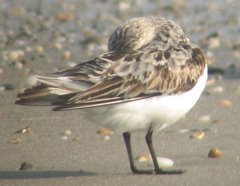
I apologize for the recent dearth of commentary on this blog. I recently started a new job, and that has claimed a certain measure of my time and energy (i.e., I can't hang around the house all day with my nose in bird books any more). But I think I'm back and besides, November is on its way. You want lots of first NJ state records, November is definitely your month.
A interesting report from the birding lists today is of a briefly-seen Sulphur-bellied Flycatcher in (where else?) Cape May. Now that would be quite a first state record! Massachusetts had one on Martha's Vineyard on 12-13 November 1983, so it is not quite unknown in the Northeast (Veit & Peterson 1993).
The Sanderling in the photo isn't hiding its head due to lack of blogging embarrassment, it's just taking a nap on the beach at the South Cape May Meadows (or it was on 6 September). It shows a combination of worn feathers and brand-new ones, a real illustration of molt in action.
Monday, September 25, 2006
Anhinga
On this day in 1971, an Anhinga was seen at Cape May by K. Berlin, B. Baumann and others. The bird was soaring with Broad-winged Hawks, an unusual sight in NJ but not so out of the ordinary in places like Hazel Bazemore Hawkwatch in Corpus Christi, Texas.
Many first state records set a pattern which is reinforced by later records of the species. Not so Anhinga. The first record was a fall bird, but it took until 2005 to get another fall record of the species. That makes two fall records out of 13 total Anhinga records, so far. An oddity is a dead Anhinga found 16 January 1989 in Whiting, Ocean County. The spring records range from 24 April to 27 June, with five in May.
Anhingas are notorious for being fly-over birds that can never be relocated. These fly-overs usually leave little time for observation, which raises the odds for misidentification. A fly-over bird usually can't be independently confirmed by other birders, either, which adds to the frustration. Some species have a reputation for being "one-day wonders" but Anhingas might be "five-minute wonders." Jersey birders who've done time in Florida might be particularly frustrated, since Anhingas are so cooperative down there.
Many first state records set a pattern which is reinforced by later records of the species. Not so Anhinga. The first record was a fall bird, but it took until 2005 to get another fall record of the species. That makes two fall records out of 13 total Anhinga records, so far. An oddity is a dead Anhinga found 16 January 1989 in Whiting, Ocean County. The spring records range from 24 April to 27 June, with five in May.
Anhingas are notorious for being fly-over birds that can never be relocated. These fly-overs usually leave little time for observation, which raises the odds for misidentification. A fly-over bird usually can't be independently confirmed by other birders, either, which adds to the frustration. Some species have a reputation for being "one-day wonders" but Anhingas might be "five-minute wonders." Jersey birders who've done time in Florida might be particularly frustrated, since Anhingas are so cooperative down there.
Thursday, September 14, 2006
Long-billed Curlew
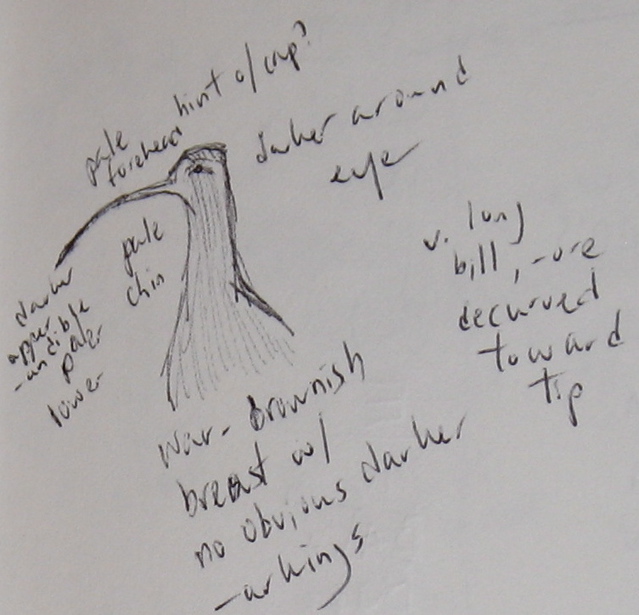
On this day in 1880, Dr. W. L. Abbott shot a Long-billed Curlew on Five Mile Beach in Cape May County. This barrier island currently hosts the Wildwoods.
Stone (1965) said the Cape May gunners called it the Sickle-bill. In Absecon, Pleasantville and Somers Point they called it Buzzard Curlew. The Pleasantville gunners also inclined towards naming it Smoker, Old Smoker or Lousy-bill; in Cape May Court House, it was Mowyer. Perhaps the Tuckerton gunners had a line in to the AOU when they called it Long-billed Curlew (Trumbull 1888).
In other words, Abbott's curlew may have been the first state record reviewed and accepted by the NJBRC (the specimen currently resides at the Academy of Natural Sciences in Philadelphia), but it was not the true first state record. The Long-billed Curlew was one of the shorebirds that was favored by market gunners and, as a result, almost shot out of existence. The Eskimo Curlew was another casualty of this profession. Alexander Wilson wrote about the regular migrations of the species through NJ in mid-May and September; he wrote in 1812. By the time W. E. D. Scott visited Long Beach in April 1877, he considered it "very rare," not to mention "shy" (Stone 1965). I guess the prospect of gunplay might make anyone shy.
Almost 100 years passed between another record from Five Mile Beach in 1898 and a record from Cape May in 1987. In the late 1980s, I found birding. I developed a fascination with shorebirds, looked at field guides and thought seeing a Long-billed Curlew would be a really neat thing. I was sure I'd have to go out west to accomplish the feat, but I was wrong. My lifer Long-billed Curlew was the one that showed up in North Wildwood (a slice of bayside on Five Mile Beach) in 2002. As remarkable as this overwintering curlew was, more remarkable was its return the following year. Then there was the one that visited an airport in Whiting, in the Pine Barrens, during the day, then lit out toward Toms River in the evening. I saw that one too (the sketch that illustrates this post is of the North Wildwood curlew).
Neighboring states tell a similar story of the Long-billed Curlew; formerly abundant, then shot out by market gunners. Long Island seems to have been another favored location (Levine 1998). It still winters in the Southeast, but NJ's current birders have been very fortunate in the recent pulse of Long-billed Curlew records. May there be more to come.
Levine, Emanuel. 1998. Bull's Birds of New York State. Comstock, Ithaca, NY.
Stone, Witmer. 1965. Bird Studies at Old Cape May: An Ornithology of Coastal New Jersey. Dover, New York, NY.
Trumbull, Gurdon. 1888. Names and Portraits of Birds Which Interest Gunners. Harper & Brothers, New York, NY.
Friday, September 08, 2006
Brown Noddy
On this day in 1979, NJ got its first (and so far only) record of Brown Noddy. The bird was seen in Cape May by Pete Dunne, Dave Ward, R. Gardner and others in the wake of Hurricane David. Other David birds included nine records of Sooty Terns on 6 September 1979 (stretching from Cape May to Wyckoff in Bergen County) and a Bridled Tern in Cape May on 7 September 1979.
Thursday, September 07, 2006
Eurasian Collared-Dove
On this day in 1997, Paul Lehman found a Eurasian Collared-Dove perched on top of a utility pole on Alexander Ave. in Cape May Point. Although word went out immediately, the bird had departed by the time the first chaser arrived ten minutes later (Lehman 1998). The bird could not be relocated.
The Eurasian Collared-Dove made an explosive colonization of Europe in the last century and now looks poised to add North America to its portfolio. The original source of the North American population is unclear, and the issue is muddied by birds that have escaped or been released from captivity (Romagosa and McEneaney 1999). What is apparent is that NJ birders need to be prepared for more records of these doves. At this writing, there are five accepted records for NJ: four from Cape May and one from Sandy Hook (Barnes et al. in litt.). There are two records each for May and September, and one for July.
Since doves may give only fleeting views, it's crucial for birders to concentrate on details of the wing pattern and undertail pattern to clinch this identification. Hybrids with Ringed Turtle-Dove need to be ruled out. Knowing the distinctive call of this dove may help, too.
When House Sparrows and European Starlings arrived in this country, many bird students of the day found them beneath notice because of their captive origins. As a result, we have a spotty record of the nature of their expansion across the continent. Hopefully we will not make the same mistake when it comes to tracking the Eurasian Collared-Dove.
Barnes, Scott, Joe Burgiel, Vince Elia, Jennifer Hanson, & Laurie Larson. In litt. New Jersey Bird Records Committee: Annual Report 2006. New Jersey Birds Fall 2006 issue.
Lehman, Paul. 1998. A Eurasian Collared-Dove at Cape May: First Sighting in New Jersey. Records of New Jersey Birds 24:5-6.
Romagosa, Christina M., & Terry McEneaney. 1999. Eurasian Collared-Dove in North America and the Caribbean. North American Birds 53:348-353.
The Eurasian Collared-Dove made an explosive colonization of Europe in the last century and now looks poised to add North America to its portfolio. The original source of the North American population is unclear, and the issue is muddied by birds that have escaped or been released from captivity (Romagosa and McEneaney 1999). What is apparent is that NJ birders need to be prepared for more records of these doves. At this writing, there are five accepted records for NJ: four from Cape May and one from Sandy Hook (Barnes et al. in litt.). There are two records each for May and September, and one for July.
Since doves may give only fleeting views, it's crucial for birders to concentrate on details of the wing pattern and undertail pattern to clinch this identification. Hybrids with Ringed Turtle-Dove need to be ruled out. Knowing the distinctive call of this dove may help, too.
When House Sparrows and European Starlings arrived in this country, many bird students of the day found them beneath notice because of their captive origins. As a result, we have a spotty record of the nature of their expansion across the continent. Hopefully we will not make the same mistake when it comes to tracking the Eurasian Collared-Dove.
Barnes, Scott, Joe Burgiel, Vince Elia, Jennifer Hanson, & Laurie Larson. In litt. New Jersey Bird Records Committee: Annual Report 2006. New Jersey Birds Fall 2006 issue.
Lehman, Paul. 1998. A Eurasian Collared-Dove at Cape May: First Sighting in New Jersey. Records of New Jersey Birds 24:5-6.
Romagosa, Christina M., & Terry McEneaney. 1999. Eurasian Collared-Dove in North America and the Caribbean. North American Birds 53:348-353.
Friday, September 01, 2006
Witmer Stone goes for a stroll
On this day in 1920, Witmer Stone walked from Cape May to Cape May Point and wound up with a list of 86 species. He didn't give any further details on his "big morning" when he mentioned it in Bird Studies at Old Cape May, unfortunately. Elsewhere in the same work, Stone gave cumulative month lists for Cape May; September's total was 213, so he saw 40 percent of that total on his morning walk.
I think it's appropriate to start this blog with a moment in the life of Witmer Stone. Today we think of him as the authority who published three noteworthy books on NJ's avifauna; one of them, the aforementioned Bird Studies, may be one of the greatest bird books of all time. He was also a pivotal figure in the history of the Delaware Valley Ornithological Society (DVOC); James A. G. Rehn called Stone, "the most outstanding figure in [the DVOC's] history" in the obituary that he penned for Cassinia. This obituary was reprinted as part of the front matter in Dover's reissue of Bird Studies in Old Cape May and does a better job than I ever could of stating Stone's background and accomplishments. You can find a PDF of an expanded version of it that was printed in the Auk on SORA (Searchable Ornithological Research Archive).
One thing that Stone devoted much time to was the compilation of bibliographies. The Birds of New Jersey, Their Nests and Eggs has an extensive bibliography; this was Stone's best attempt to compile an all-inclusive list of sources for NJ ornithology. Later issues of Cassinia followed the tradition with updates containing the most recent publications on the state's birdlife. I suspect this love of bibliography came from the example of Stone's father Frederick, who was a historian and Librarian of the Historical Society of Pennsylvania. Of course, the eminent ornithologist Elliott Coues was also badly bitten by the bibliographic bug, so Stone was hardly the first bird student to fall prey to this malady.
Bibliography, in the end, is about looking back the way we've come, and Stone put this historical impulse to good use, particularly in his Cape May magnum opus. We would know far less about NJ's birdlife if he hadn't looked back from his own time. This is the heritage of all NJ birders. All of us depend on the vast body of records and reports that were accumulated, published and compiled by others. We are lucky to bird in a state with such a long ornithological history; much of the knowledge we take for granted, that we pick up by osmosis as we learn to bird, was discovered by others. That's what this blog is all about.
Returning to Stone's morning walk, I wondered if I could compare it to modern birding, numbers-wise. ABA's 2005 Big Day Report gives a NJ September Big Day record of 144, but of course this isn't for Cape May exclusively; ABA doesn't keep county listing milestones (alas). I pulled out David Sibley's The Birds of Cape May but realized that Sibley treats the entire county, while Stone's area was confined to Cape Island and the oceanfront up as far as Avalon. Time is on our side as well; the longer you wait for certain vagrants to show up, the better the probability they will (never mind birds like Cattle Egret which were unknown in the state when Stone wrote). So an exact comparison is not to be had. On the other hand, comparing Stone's month lists and Sibley's bar graphs is a very instructive exercise that I recommend to anyone who has access to both books.
I think it's appropriate to start this blog with a moment in the life of Witmer Stone. Today we think of him as the authority who published three noteworthy books on NJ's avifauna; one of them, the aforementioned Bird Studies, may be one of the greatest bird books of all time. He was also a pivotal figure in the history of the Delaware Valley Ornithological Society (DVOC); James A. G. Rehn called Stone, "the most outstanding figure in [the DVOC's] history" in the obituary that he penned for Cassinia. This obituary was reprinted as part of the front matter in Dover's reissue of Bird Studies in Old Cape May and does a better job than I ever could of stating Stone's background and accomplishments. You can find a PDF of an expanded version of it that was printed in the Auk on SORA (Searchable Ornithological Research Archive).
One thing that Stone devoted much time to was the compilation of bibliographies. The Birds of New Jersey, Their Nests and Eggs has an extensive bibliography; this was Stone's best attempt to compile an all-inclusive list of sources for NJ ornithology. Later issues of Cassinia followed the tradition with updates containing the most recent publications on the state's birdlife. I suspect this love of bibliography came from the example of Stone's father Frederick, who was a historian and Librarian of the Historical Society of Pennsylvania. Of course, the eminent ornithologist Elliott Coues was also badly bitten by the bibliographic bug, so Stone was hardly the first bird student to fall prey to this malady.
Bibliography, in the end, is about looking back the way we've come, and Stone put this historical impulse to good use, particularly in his Cape May magnum opus. We would know far less about NJ's birdlife if he hadn't looked back from his own time. This is the heritage of all NJ birders. All of us depend on the vast body of records and reports that were accumulated, published and compiled by others. We are lucky to bird in a state with such a long ornithological history; much of the knowledge we take for granted, that we pick up by osmosis as we learn to bird, was discovered by others. That's what this blog is all about.
Returning to Stone's morning walk, I wondered if I could compare it to modern birding, numbers-wise. ABA's 2005 Big Day Report gives a NJ September Big Day record of 144, but of course this isn't for Cape May exclusively; ABA doesn't keep county listing milestones (alas). I pulled out David Sibley's The Birds of Cape May but realized that Sibley treats the entire county, while Stone's area was confined to Cape Island and the oceanfront up as far as Avalon. Time is on our side as well; the longer you wait for certain vagrants to show up, the better the probability they will (never mind birds like Cattle Egret which were unknown in the state when Stone wrote). So an exact comparison is not to be had. On the other hand, comparing Stone's month lists and Sibley's bar graphs is a very instructive exercise that I recommend to anyone who has access to both books.
Subscribe to:
Posts (Atom)