Showing posts with label "ocean county". Show all posts

Friday, April 17, 2009

White-faced Ibis


On this day in 1977, J. Galli and J. Penkala found a White-faced Ibis at Brig (aka Forsythe NWR). The bird was refound on 21 April at Tuckerton. This record was so unprecedented that it merited an S.A. in the relevant issue of American Birds. From that issue: "This is a first regional record, and the fourth for the east" (Paxton et al. 1977).

Since then, White-faced Ibises have become almost routine in the state. World Series of Birding teams try to pin them down in the spring, and the typical intermittent reports of them at locations like Brig over the summer challenge birders while at the same time encouraging them to ignore the ibises as routine birds.

Paxton, Robert O., Paul A. Buckley, & David A. Cutler. 1977. The Spring Migration, Hudson-Delaware Region. American Birds 31:979-984.

Saturday, April 04, 2009

Tuckerton Bird Names


Dowitcher Decoy
Originally uploaded by ammodramus88
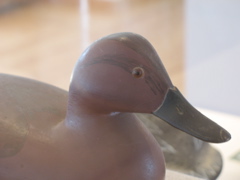
Continuing in a series of old bird names from various Jersey locations drawn from Gurdon Trumbull's Names and Portraits of Birds..., this list is of Tuckerton bird names. The decoy that illustrates this post probably would've been considered a brown-back.

Bay-coot - Surf Scoter
Big Yellow-legged Plover - Greater Yellowlegs
Black-breast - Dunlin
Black-breast Plover - Black-bellied Plover
Blaten Duck - Gadwall
Brant-snipe - Dunlin
Broad-bill - Greater Scaup
Brown-back - Short-billed Dowitcher
Bull-head - Black-bellied Plover
Cock-robin - Hooded Merganser
Cock-robin Duck - Hooded Merganser
Creek Broad-bill - Lesser Scaup
Crow-duck - American Coot
Cub-head - Common Goldeneye
Fat-bird - Pectoral Sandpiper
Field Plover - Upland Sandpiper
Fresh-water Sheldrake - Common Merganser
Gannet - Ruddy Turnstone
Long-billed Curlew - Long-billed Curlew
Marlin - Marbled Godwit
Mud-hen - Clapper Rail
Quill-tail Coot - Ruddy Duck
Robin-snipe - Red Knot
Salt-water Sheldrake - Red-breasted Merganser
Short-billed Curlew - Whimbrel
Shovel-bill - Northern Shoveller
Sleepy Broad-bill - Ruddy Duck
Small Yellow-legged Plover - Lesser Yellowlegs
Smees - Northern Pintail
Smethe - Northern Pintail
Sprig-tail - Northern Pintail
Telltale - Greater Yellowlegs, Lesser Yellowlegs
Winter Snipe - Dunlin

Saturday, February 28, 2009

Barnegat Bird Names


Harlequin Ducks
Originally uploaded by ammodramus88
A trip out the jetty at Barnegat last weekend provides an excuse to list some historic game bird names from Barnegat gunners (via Trumbull's Names and Portraits of Birds...

Big Yellow-leg - Greater Yellowlegs
Black-breast Plover - Black-bellied Plover
Blaten Duck - Gadwall
Brant-snipe - Dunlin
Broad-bill - Greater Scaup
Brown-back - Short-billed Dowitcher
Checkered-snipe - Ruddy Turnstone
Cock-robin - Hooded Merganser
Cock-robin Duck - Hooded Merganser
Crow-duck - American Coot
Cub-head - Common Goldeneye
Dowitch - Short-billed Dowitcher
Field Plover - Upland Sandpiper
Fresh-water Broad-bill - Lesser Scaup
Fresh-water Sheldrake - Common Merganser
Gray Plover - Black-belled Plover
Krieker - Pectoral Sandpiper
Large Yellow-leg - Greater Yellowlegs
Little Yellow-leg - Lesser Yellowlegs
Marlin - Marbled Godwit
Mud-hen - Clapper Rail
Ring-tailed Marlin - Hudsonian Godwit
Robin-snipe - Red Knot
Salt-water Sheldrake - Red-breasted Merganser
Sleepy Broad-bill - Ruddy Duck
Small Curlew - Whimbrel
Small Yellow-leg - Lesser Yellowlegs
Spoon-bill - Northern Shoveller
Sprig-tail - Northern Pintail
Telltale - Greater Yellowlegs, Lesser Yellowlegs

The birds that illustrate this post, Harlequin Ducks, are generally expected by birders visiting Barnegat today, but according to Trumbull in the day, did not get much south of Salem, Massachusetts. In their accepted range, they were usually known as "lord and lady."

Tuesday, February 24, 2009

Bridled Tern

On this day in 1951, Evelyn and Quintin Kramer found a carcass of a long-dead Bridled Tern at Island Beach State Park in Ocean County. Subsequent records of the species have been associated with hurricanes and tropical storms, when it is almost expected (if not quite as common as Sooty Tern in these circumstances).

The obituary of Quintin Kramer that appeared in Cassinia contains the following: "During World War II, Quintin and Evelyn did most of their birding by public transportation and shank's mare. They walked the Jersey beaches for miles and found numerous dead birds, including an occasional rare species" (Peniston 1976). Presumably, this tern was carried north with a tropical storm during the summer of 1950. Unisys shows 13 storms for that season; the likeliest candidates to drop a tropical tern in NJ would seem to be Able and Dog (but I'm open to contrary opinions from those who have studied the intersection of hurricanes and birds in more detail than I have). In any case, the Kramers came along after the fact, and the specimen in question now resides at the Academy of Natural Sciences in Philadelphia.

Peniston, Howell. 1976. Quintin Kramer 1908-1975. Cassinia 56: 6. PDF here

Thursday, October 02, 2008

Ruff

On this day in 1932, Charles Urner found two Ruffs near Tuckerton, Ocean County. In that day, on the cusp between specimen and sight identification, Urner took no specimens but notes, then repaired to specimens to double-check his conclusions. This was not the first record of Ruff for NJ, since there was at least one previous specimen record cited in Chapman (1906).

In subsequent years, Ruffs became synonymous with Pedricktown in springtime, but that is not so much the case now. They seem to be easier to find in Delaware than Jersey these days, at least in spring.

Urner, Charles A. 1933. The Ruff in New Jersey. Auk 50:101. PDF here

Saturday, February 03, 2007

Ivory Gull

On this day in 1940, Herbert Cutler found a dead Ivory Gull washed up on the beach at Island Beach in Ocean County. He was accompanied by William Yoder, Jr., Quintin and Evelyn Kramer, Morris Finkel and Jack Herre (Cutler 1940). The bird was an adult; the specimen is now in the collection of the Academy of Natural Sciences in Philadelphia.

Cutler's Ivory Gull note appears in a special section of the Auk devoted to unusual bird records stemming from the harsh weather in the winter of 1939-1940. Ivory Gulls were seen in larger numbers than normal in the Gulf of St. Lawrence (Taverner 1940) and one made it as far south as Mt. Desert Island in Maine (Sullivan 1940). The NJ bird was the most southerly record up to that time, but it was clearly part of a larger pattern.

Apart from the cold weather, another unusual circumstance contributed to this record. Although the United States had yet to enter World War II in January 1940, German U-boats were patrolling the north Atlantic. As Walters (2004) puts it, "There was the time when German U-Boats were sinking ships off the Jersey Coast, casting oiled seabirds inland, many to their deaths. Right on the spot appeared the 'Dead Birding Clan': Dave [Cutler] and a gang of others (the Kramers, Harry Goldstein, and Herb Cutler). They picked up dozens of dead alcids in several weekends of systematic beach surveys...Herb Cutler found the first dead Ivory Gull ever for New Jersey on one of these weekends."

There have only been two other NJ Ivory Gull records since 1940; one was at Manasquan Inlet from 28 January to 5 February 1955. The other appeared at Lake Como on the North Shore on 10 February 1986, then reappeared at Liberty State Park on 16 February. From this spread of dates, one can conclude that late January and early February is the right season for an Ivory Gull in NJ, but the steady increase in climate warming suggests that this is one of the least likely vagrants to visit NJ in the future.

Cutler, Herbert S. 1940. Ivory Gull in New Jersey. Auk 57:403-404. PDF here
Sullivan, Maurice. 1940. Ivory Gull from Mount Desert Island, Maine. Auk 57:403. PDF here
P. A. Taverner. 1940. Ivory Gulls in the Gulf of St. Lawrence. Auk 57:402-403. PDF here
Walters, Chris. 2004. Adventures in Birding: The Dave Cutler Story. Philadelphia Larus 31(1):1, 4-5. PDF here

Tuesday, October 17, 2006

Field Trip: Tuckerton Seaport


This is the first in an occasional series of posts about NJ's bird history. These "Field Trip" posts will involve actual gadding about in the Garden State, as opposed to merely sticking one's nose in a bird book.

Tuckerton Seaport may not be the greatest vagrant trap in the state, but there's plenty on hand to interest the historically-minded birder. Tuckerton Seaport is a project of the Barnegat Bay Decoy and Baymen's Museum. Recreated buildings such as a lighthouse, boat-builder's shop and hunting lodges (among others), line the waterway. Exhibits inside each building give information on the history of different industries and crafts on the Atlantic bayshore of NJ. There are also docents and crafters demonstrating pursuits such as decoy-carving and boat-building.

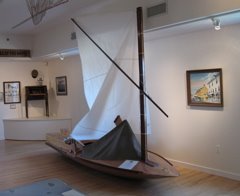
The Barnegat Bay area is the home of the sneakbox, a unique craft intended for waterfowling. The boat's shallow draft makes for a stable craft that is at home navigating bayside marshes, even in shallow water. Its low profile (combined with camouflaging techniques, such as tying bunches of marsh grass onto the boat's deck) makes it easier for hunters to sneak up on their quarry. It can be rowed or sailed; it can also take an outboard motor on the stern.

One building of interest is the recreation of the Hester Sedge Gun Club, which is intended to show a typical hunting "shack" from the 1940s. Among other fixtures, it has a "punt" or market gun hanging on the wall. Punts were outlawed with the passage of the National Migratory Bird Act in 1918, but they were the favored weaponry of market gunners before then.

Like it or not, much of the avian history chronicled at Tuckerton Seaport involves hunting. Even decoys, often considered innocuous decorative items, were originally intended to be tools used to hunt birds more effectively. In addition to decoy carvers demonstrating their skills at the Seaport, a collection of decoys is housed in a recreation of the Marshelder Gun Club. One of the decoys on display is this Cinnamon Teal carved by John Updike (not the novelist) of Green Bank. Since Cinnamon Teal is a Review List species in NJ, I found myself pondering a records committee circulation that included a decoy among the documentation. But I digress.

Tuckerton Seaport is open daily to the end of October, then on weekends until 18 December. The spring season starts in May. In addition to its exhibits, the Seaport offers classes in decoy-carving and other crafts.

Tuesday, September 26, 2006

Le Conte's Sparrow

On this day in 1976, a Le Conte's Sparrow was found at Tuckerton in Ocean County by Richard Ryan, K. Richards, and Frank and Barb Haas; the bird stayed until 2 October and many others also saw it. This species, one of the skulking Ammodramus sparrows, has seen a marked upsurge in the Northeast in recent decades; at least some of this has to be due to the fact that there are more observers in the field, and more knowledge about identifying Le Conte's Sparrows. New York has a specimen record from 1897 near Ithaca, so the species is not a newcomer to the region (Levine 1998). It will always be a challenge for an observer to find a Le Conte's Sparrow, however, whether the birding technology of choice is optical equipment or a shotgun.

Of NJ's 24 records so far, 20 have come since 1990. Other Northeastern states show a similar temporal pattern. Although Cape May has seven Le Conte's records, Monmouth County has nine, helped in large part by the north end of Sandy Hook. The first state record was a tad early, as it turned out; about 50 percent of NJ Le Conte's records come from October. So get out your field guides and study up; both Grasshopper Sparrow and Sharp-tailed Seaside Sparrow bear a passing resemblance to Le Conte's Sparrow.

Levine, Emanuel. 1998. Bull's Birds of New York State. Comstock, Ithaca, NY.

Saturday, September 23, 2006

Black-throated Gray Warbler

On this day in 1956, W. Parker, Ed Bloor and Charles Rogers found a Black-throated Gray Warbler at Tuckerton in Ocean County.

September is the peak month in NJ and most nearby states for this dapper-looking Western stray. NJ has 19 records of the species at this writing, nine of which are September records. Two-thirds of these occur in the span between 20 September and the end of the month. Most of the rest of the state's records come from fall, going into December in two cases; there are a couple of "early" records for August as well. There are only two spring records. In other words, this species shows a temporal pattern typical of a Western vagrant, although its occurrence peaks earlier in the season than the many Western species that have made November a month to be reckoned with for rarity-chasers.

No fewer than four individuals have been banded at Island Beach State Park in Ocean County, while there are seven accepted records from Cape May (and Sibley 1997 lists two more reports) (Hanson 2002-2003). Although at first glance, the species shows up in the expected coastal vagrant traps, there are also six inland records scattered across the state from Franklin in Sussex County to Mickleton in Gloucester County. One real oddity is that the species has never been recorded at Sandy Hook, which would seem like an obvious site for it to turn up.

Black-throated Gray Warbler is not quite annual in NJ, but it is a regular rarity, so most birders will get a chance to chase one sooner rather than later.

Hanson, Jennifer W. 2002-2003. The Status of Black-throated Gray and Townsend's Warblers in New Jersey. Records of New Jersey Birds 28:24-78.
Sibley, David. 1997. The Birds of Cape May. New Jersey Audubon Society, Bernardsville, NJ. Second edition.

Friday, September 22, 2006

Cassin's Sparrow

On this day in 1961, a Cassin's Sparrow was netted and collected by Mabel Warburton at Island Beach State Park as part of Operation Recovery. The specimen ultimately went to the American Museum of Natural History in New York to have the identification confirmed. It was aged as an immature (Swinebroad 1966).

Cassin's Sparrow is a very rare vagrant in the East; there are a few records for the Midwest. One bird made it all the way to Seal Island, Nova Scotia in 1974; that was a spring bird (Tufts 1986). More recently, another turned up at Jones Beach State Park in New York in early October 2000. Two birds scarcely make a pattern of occurrence, of course. It is tempting to speculate, however, that if NJ ever gets another Cassin's Sparrow, a place like Sandy Hook would be as good as any for it to touch down.

Swinebroad, Jeff. 1966. Cassin's Sparrow in New Jersey. Auk 83:129. PDF here
Tufts, Robie W. 1986. Birds of Nova Scotia. Nimbus/Nova Scotia Museum, Halifax, Nova Scotia. Third edition.

Friday, September 15, 2006

Bell's Vireo

On this day in 1959, a Bell's Vireo was netted by Mr. and Mrs. Albert Schnitzler and subsequently collected by Joseph Jehl, Jr., at Island Beach State Park in Ocean County (Jehl 1960). That bird, an immature female, was found just ten days before another Bell's Vireo was caught and banded a little to the north at Tiana Beach near Shinnecock Inlet on Long Island, New York (Bull 1975). Prior to these records, the only other unequivocal Eastern record was a bird taken on 11 November 1897 in Durham, New Hampshire (Jehl 1960).

There was a gap between this first record and more recent ones, which started in 1994. All four of the recent records come that rarity vortex, Cape May. One of these birds occurred exactly 39 years to the day after the first state record, but the others have come later in fall. One appeared for a few days in October-November 1994; the other two stayed for a month from December into January (one in 1996-1997 and one in 2001-2002).

Bell's Vireo is one of the more uncommon western strays; New Jersey and New York have the most records in the region. There are a number of sight reports, but this species must be identified with care.

Bull, John. 1975. Birds of the New York Area. Dover, New York, NY.
Jehl, Joseph R., Jr. 1960. Bell's Vireo in New Jersey. Wilson Bulletin 72:404. PDF here

Saturday, September 09, 2006

Lesser Black-backed Gull

On this day in 1934, Charles Urner and James L. Edwards found a Lesser Black-backed Gull at Beach Haven in Ocean County. Not only was this bird a first for NJ, it was the first North American record outside of Greenland (Edwards 1935, Post & Lewis 1995).

More records of this species accumulated, at first slowly but then more quickly, so that the Lesser Black-backed Gull is now a regular part of NJ's avifauna. Walsh et al. (1999) give a high count of 53 birds at Florence in Burlington County on 20 March 1997. Florence, of course, is just across the Delaware River from the massive Tullytown dump in Pennsylvania, a location that concentrates gulls. That high count has since been eclipsed on more than one occasion; the current state high count of Lesser Black-backed Gulls was made by Ward Dasey at Florence on 15 November 2003 and amounted to 214+ birds (Driver 2004). As numbers have increased, so have sightings of immature birds, and records can now be found throughout the year, even during the summer. It seems probable that this species must nest somewhere in North America, but there is still no hard proof. Sightings have increased across the country, but the East Coast is still this species' stronghold.

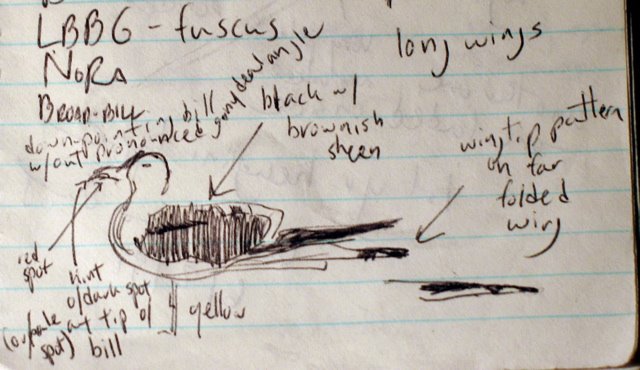
Walsh et al. state that southward-bound migrants occur "early in the fall, usually by mid-September." This fits perfectly with the date of the first record. Although graellsii of western Europe is the expected subspecies, Edwards' description of the first NJ bird states that the bird's back color appeared to be the same as that of Great Black-backed Gulls nearby; the observers circled the bird to make sure that the angle of the light was not affecting the bird's appearance. As a result, the observers thought that the subspecies involved was fuscus, which is native to northern Scandinavia. Adult birds of the subspecies intermedius, which occurs further south in Scandinavia, also have a black mantle, while adult graellsii birds have a slaty mantle that contrasts with black wingtips. Today's birders also have to consider the so-called "Dutch intergrades" between graellsii and intermedius when confronted by a Lesser Black-backed Gull with a darker-than-normal mantle (Post & Lewis 1995). Light conditions and the angle of the bird respective to the observer can also make dramatic differences in the apparent shade of a gull's mantle.

As anyone who has dabbled in gull identification knows, it is often a frustrating pursuit. However, I still find that a day with an elegant, long-winged Lesser Black-backed Gull on the list is a good day in the field.

(Illustrative disclaimer: these field notes were not taken in NJ. They were actually taken at the Kuusamo dump in Finland, and they attempt to depict an adult fuscus Lesser Black-back.)

Driver, Paul J. 2004. 2003 Fall Field Notes, Region 4. New Jersey Birds 30:15-18.
Edwards, James L. 1935. The Lesser Black-backed Gull in New Jersey. Auk 52:85. PDF here
Post, Peter W., & Robert H. Lewis. 1995. The Lesser Black-backed Gull in the Americas: Occurrence and Subspecific Identity. Birding 27:282-290; 370-380.
Walsh, Joan, Vince Elia, Rich Kane, & Thomas Halliwell. 1999. Birds of New Jersey. New Jersey Audubon Society, Bernardsville, NJ.