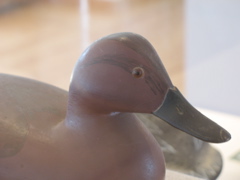
Continuing in a series of old bird names from various Jersey locations drawn from Gurdon Trumbull's Names and Portraits of Birds..., this list is of Tuckerton bird names. The decoy that illustrates this post probably would've been considered a brown-back.
Bay-coot - Surf Scoter
Big Yellow-legged Plover - Greater Yellowlegs
Black-breast - Dunlin
Black-breast Plover - Black-bellied Plover
Blaten Duck - Gadwall
Brant-snipe - Dunlin
Broad-bill - Greater Scaup
Brown-back - Short-billed Dowitcher
Bull-head - Black-bellied Plover
Cock-robin - Hooded Merganser
Cock-robin Duck - Hooded Merganser
Creek Broad-bill - Lesser Scaup
Crow-duck - American Coot
Cub-head - Common Goldeneye
Fat-bird - Pectoral Sandpiper
Field Plover - Upland Sandpiper
Fresh-water Sheldrake - Common Merganser
Gannet - Ruddy Turnstone
Long-billed Curlew - Long-billed Curlew
Marlin - Marbled Godwit
Mud-hen - Clapper Rail
Quill-tail Coot - Ruddy Duck
Robin-snipe - Red Knot
Salt-water Sheldrake - Red-breasted Merganser
Short-billed Curlew - Whimbrel
Shovel-bill - Northern Shoveller
Sleepy Broad-bill - Ruddy Duck
Small Yellow-legged Plover - Lesser Yellowlegs
Smees - Northern Pintail
Smethe - Northern Pintail
Sprig-tail - Northern Pintail
Telltale - Greater Yellowlegs, Lesser Yellowlegs
Winter Snipe - Dunlin
Showing posts with label tuckerton. Show all posts
Showing posts with label tuckerton. Show all posts
Saturday, April 04, 2009


Thursday, October 02, 2008
Ruff
On this day in 1932, Charles Urner found two Ruffs near Tuckerton, Ocean County. In that day, on the cusp between specimen and sight identification, Urner took no specimens but notes, then repaired to specimens to double-check his conclusions. This was not the first record of Ruff for NJ, since there was at least one previous specimen record cited in Chapman (1906).
In subsequent years, Ruffs became synonymous with Pedricktown in springtime, but that is not so much the case now. They seem to be easier to find in Delaware than Jersey these days, at least in spring.
Urner, Charles A. 1933. The Ruff in New Jersey. Auk 50:101. PDF here
In subsequent years, Ruffs became synonymous with Pedricktown in springtime, but that is not so much the case now. They seem to be easier to find in Delaware than Jersey these days, at least in spring.
Urner, Charles A. 1933. The Ruff in New Jersey. Auk 50:101. PDF here
Tuesday, October 17, 2006
Field Trip: Tuckerton Seaport

This is the first in an occasional series of posts about NJ's bird history. These "Field Trip" posts will involve actual gadding about in the Garden State, as opposed to merely sticking one's nose in a bird book.
Tuckerton Seaport may not be the greatest vagrant trap in the state, but there's plenty on hand to interest the historically-minded birder. Tuckerton Seaport is a project of the Barnegat Bay Decoy and Baymen's Museum. Recreated buildings such as a lighthouse, boat-builder's shop and hunting lodges (among others), line the waterway. Exhibits inside each building give information on the history of different industries and crafts on the Atlantic bayshore of NJ. There are also docents and crafters demonstrating pursuits such as decoy-carving and boat-building.
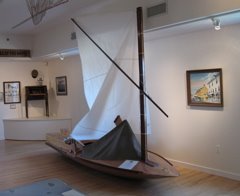
The Barnegat Bay area is the home of the sneakbox, a unique craft intended for waterfowling. The boat's shallow draft makes for a stable craft that is at home navigating bayside marshes, even in shallow water. Its low profile (combined with camouflaging techniques, such as tying bunches of marsh grass onto the boat's deck) makes it easier for hunters to sneak up on their quarry. It can be rowed or sailed; it can also take an outboard motor on the stern.

One building of interest is the recreation of the Hester Sedge Gun Club, which is intended to show a typical hunting "shack" from the 1940s. Among other fixtures, it has a "punt" or market gun hanging on the wall. Punts were outlawed with the passage of the National Migratory Bird Act in 1918, but they were the favored weaponry of market gunners before then.
Like it or not, much of the avian history chronicled at Tuckerton Seaport involves hunting. Even decoys, often considered innocuous decorative items, were originally intended to be tools used to hunt birds more effectively. In addition to decoy carvers demonstrating their skills at the Seaport, a collection of decoys is housed in a recreation of the Marshelder Gun Club. One of the decoys on display is this Cinnamon Teal carved by John Updike (not the novelist) of Green Bank. Since Cinnamon Teal is a Review List species in NJ, I found myself pondering a records committee circulation that included a decoy among the documentation. But I digress.
Tuckerton Seaport is open daily to the end of October, then on weekends until 18 December. The spring season starts in May. In addition to its exhibits, the Seaport offers classes in decoy-carving and other crafts.
Tuesday, September 26, 2006
Le Conte's Sparrow
On this day in 1976, a Le Conte's Sparrow was found at Tuckerton in Ocean County by Richard Ryan, K. Richards, and Frank and Barb Haas; the bird stayed until 2 October and many others also saw it. This species, one of the skulking Ammodramus sparrows, has seen a marked upsurge in the Northeast in recent decades; at least some of this has to be due to the fact that there are more observers in the field, and more knowledge about identifying Le Conte's Sparrows. New York has a specimen record from 1897 near Ithaca, so the species is not a newcomer to the region (Levine 1998). It will always be a challenge for an observer to find a Le Conte's Sparrow, however, whether the birding technology of choice is optical equipment or a shotgun.
Of NJ's 24 records so far, 20 have come since 1990. Other Northeastern states show a similar temporal pattern. Although Cape May has seven Le Conte's records, Monmouth County has nine, helped in large part by the north end of Sandy Hook. The first state record was a tad early, as it turned out; about 50 percent of NJ Le Conte's records come from October. So get out your field guides and study up; both Grasshopper Sparrow and Sharp-tailed Seaside Sparrow bear a passing resemblance to Le Conte's Sparrow.
Levine, Emanuel. 1998. Bull's Birds of New York State. Comstock, Ithaca, NY.
Of NJ's 24 records so far, 20 have come since 1990. Other Northeastern states show a similar temporal pattern. Although Cape May has seven Le Conte's records, Monmouth County has nine, helped in large part by the north end of Sandy Hook. The first state record was a tad early, as it turned out; about 50 percent of NJ Le Conte's records come from October. So get out your field guides and study up; both Grasshopper Sparrow and Sharp-tailed Seaside Sparrow bear a passing resemblance to Le Conte's Sparrow.
Levine, Emanuel. 1998. Bull's Birds of New York State. Comstock, Ithaca, NY.
Saturday, September 23, 2006
Black-throated Gray Warbler
On this day in 1956, W. Parker, Ed Bloor and Charles Rogers found a Black-throated Gray Warbler at Tuckerton in Ocean County.
September is the peak month in NJ and most nearby states for this dapper-looking Western stray. NJ has 19 records of the species at this writing, nine of which are September records. Two-thirds of these occur in the span between 20 September and the end of the month. Most of the rest of the state's records come from fall, going into December in two cases; there are a couple of "early" records for August as well. There are only two spring records. In other words, this species shows a temporal pattern typical of a Western vagrant, although its occurrence peaks earlier in the season than the many Western species that have made November a month to be reckoned with for rarity-chasers.
No fewer than four individuals have been banded at Island Beach State Park in Ocean County, while there are seven accepted records from Cape May (and Sibley 1997 lists two more reports) (Hanson 2002-2003). Although at first glance, the species shows up in the expected coastal vagrant traps, there are also six inland records scattered across the state from Franklin in Sussex County to Mickleton in Gloucester County. One real oddity is that the species has never been recorded at Sandy Hook, which would seem like an obvious site for it to turn up.
Black-throated Gray Warbler is not quite annual in NJ, but it is a regular rarity, so most birders will get a chance to chase one sooner rather than later.
Hanson, Jennifer W. 2002-2003. The Status of Black-throated Gray and Townsend's Warblers in New Jersey. Records of New Jersey Birds 28:24-78.
Sibley, David. 1997. The Birds of Cape May. New Jersey Audubon Society, Bernardsville, NJ. Second edition.
September is the peak month in NJ and most nearby states for this dapper-looking Western stray. NJ has 19 records of the species at this writing, nine of which are September records. Two-thirds of these occur in the span between 20 September and the end of the month. Most of the rest of the state's records come from fall, going into December in two cases; there are a couple of "early" records for August as well. There are only two spring records. In other words, this species shows a temporal pattern typical of a Western vagrant, although its occurrence peaks earlier in the season than the many Western species that have made November a month to be reckoned with for rarity-chasers.
No fewer than four individuals have been banded at Island Beach State Park in Ocean County, while there are seven accepted records from Cape May (and Sibley 1997 lists two more reports) (Hanson 2002-2003). Although at first glance, the species shows up in the expected coastal vagrant traps, there are also six inland records scattered across the state from Franklin in Sussex County to Mickleton in Gloucester County. One real oddity is that the species has never been recorded at Sandy Hook, which would seem like an obvious site for it to turn up.
Black-throated Gray Warbler is not quite annual in NJ, but it is a regular rarity, so most birders will get a chance to chase one sooner rather than later.
Hanson, Jennifer W. 2002-2003. The Status of Black-throated Gray and Townsend's Warblers in New Jersey. Records of New Jersey Birds 28:24-78.
Sibley, David. 1997. The Birds of Cape May. New Jersey Audubon Society, Bernardsville, NJ. Second edition.
Subscribe to:
Posts (Atom)